畦 (qí) means "Small plot of land or garden bed" in Chinese. It has 11 strokes with the radical 田.
Rated 4.2/5 in difficulty (advanced).
Appears in 3+ common words including 菜畦 (cài qí), 一畦 (yī qí), 畦田 (qí tián).
Due to its 11 strokes, Hanzi Writer's error detection shows 畦 requires focused practice — most learners need 10+ attempts for consistent accuracy.
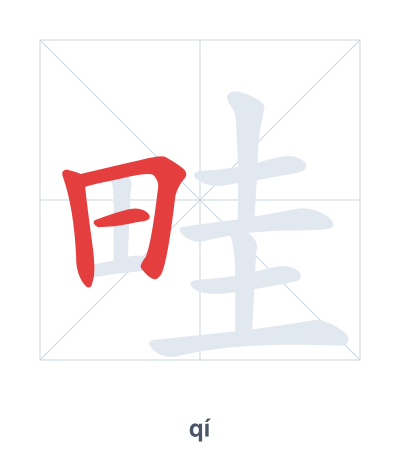
Open Hanzi Writer to see the animated stroke order and practice writing 畦 with real-time feedback.
The character 畦 (qí) is written with 11 strokes. Follow the standard Chinese stroke order: top to bottom, left to right, outside before inside. The radical 田 is one of its key components.
Practice the correct stroke order with the Hanzi Writer app to see animated stroke-by-stroke guidance with real-time feedback.
畦 means Small plot of land or garden bed.
畦 combines 田 (field) with 圭 (a jade tablet), representing small rectangular plots of land divided from a larger field, much like the shape of a jade scepter. In ancient Chinese agriculture, fields were partitioned into neat beds for irrigation and crop management.
💡 Memory Tip: Imagine a field (田) divided into tiny garden beds, each with two jade tablets (圭) marking its corners.
菜畦里种了青菜。
cài qí lǐ zhǒng le qīng cài
Green vegetables are planted in the vegetable plot.
我家有一畦韭菜。
wǒ jiā yǒu yī qí jiǔ cài
My family has a bed of chives.
这里的畦田很整齐。
zhè lǐ de qí tián hěn zhěng qí
The vegetable plots here are very neat.
Open Hanzi Writer to see the animated stroke order and practice writing 畦 with real-time feedback.
✨ Animated stroke order · Handwriting recognition · HSK-graded practice · Free to use
The character 畦 consists of the radical 田 (field) on the left, and the component 圭 (gui, meaning two layers of earth) on the right. The 田 represents the field, and 圭 suggests the raised earth borders that divide a field into small plots, which gives the meaning of a small plot of land or garden bed.