阍 (hūn) means "gatekeeper; to guard a gate" in Chinese. It has 11 strokes with the radical 门.
Rated 4.2/5 in difficulty (advanced).
Appears in 3+ common words including 阍人 (hūn rén), 阍侍 (hūn shì), 晨阍 (chén hūn).
Due to its 11 strokes, Hanzi Writer's error detection shows 阍 requires focused practice — most learners need 10+ attempts for consistent accuracy.
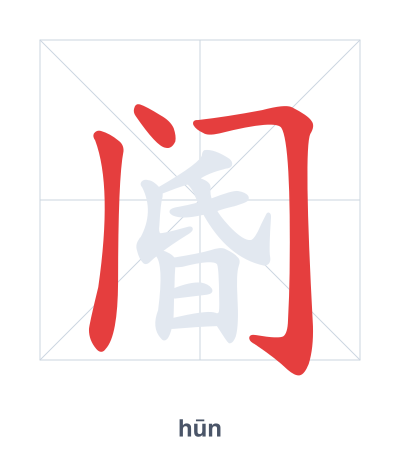
Open Hanzi Writer to see the animated stroke order and practice writing 阍 with real-time feedback.
The character 阍 (hūn) is written with 11 strokes. Follow the standard Chinese stroke order: top to bottom, left to right, outside before inside. The radical 门 is one of its key components.
Practice the correct stroke order with the Hanzi Writer app to see animated stroke-by-stroke guidance with real-time feedback.
阍 means gatekeeper; to guard a gate.
阍 is a phono-semantic compound: the radical 门 (door) indicates a gate, and 昏 (dusk) provides the sound. The original meaning is a gatekeeper who guards the gate, especially at dusk when the gate is closed for the night.
💡 Memory Tip: Imagine a gatekeeper at dusk (昏) dozing off while leaning on the gate (门), but still blocking the entrance with his sleepy body.
阍人在门口守卫着。
hūn rén zài mén kǒu shǒu wèi zhe
The gatekeeper is guarding at the door.
阍侍负责接待客人。
hūn shì fù zé jiē dài kè rén
The gatekeeper is responsible for receiving guests.
他每天早起去晨阍。
tā měi tiān zǎo qǐ qù chén hūn
He gets up early every day to pay respects to his parents.
Open Hanzi Writer to see the animated stroke order and practice writing 阍 with real-time feedback.
✨ Animated stroke order · Handwriting recognition · HSK-graded practice · Free to use
阍 is made of the radical 门 (gate) on the outside and 昏 (dusk) on the inside. The 门 radical shows the character is related to gates, and 昏 provides the pronunciation. Together, they suggest a gatekeeper who works at dusk.