晨 (chén) means "Morning" in Chinese. It has 11 strokes with the radical 日, and is HSK Level 2.
Rated 3.7/5 in difficulty (challenging).
Harder than 78% of HSK Level 2 characters.
Appears in 3+ common words including 早晨 (zǎo chén), 晨练 (chén liàn), 凌晨 (líng chén).
Due to its 11 strokes, Hanzi Writer's error detection shows 晨 requires focused practice — most learners need 10+ attempts for consistent accuracy.
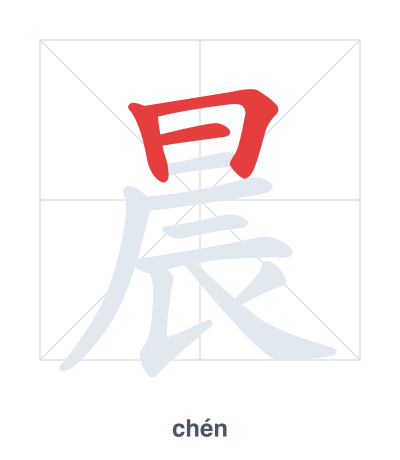
Open Hanzi Writer to see the animated stroke order and practice writing 晨 with real-time feedback.
The character 晨 (chén) is written with 11 strokes. Follow the standard Chinese stroke order: top to bottom, left to right, outside before inside. The radical 日 is one of its key components.
Practice the correct stroke order with the Hanzi Writer app to see animated stroke-by-stroke guidance with real-time feedback.
晨 means Morning.
As an HSK Level 2 character, 晨 is among the first characters beginners learn.
晨 combines the sun (日) with the time indicator 辰 (originally a pictograph of a shellfish, later used for the morning star or time), together signifying the moment of sunrise. The upper sun and lower time component depict the early morning when the sun appears.
💡 Memory Tip: Picture the sun (日) peeking over a giant clamshell (辰) to announce the morning.
早晨的空气很清新。
zǎo chén de kōng qì hěn qīng xīn
The morning air is very fresh.
爷爷每天去晨练。
yé yé měi tiān qù chén liàn
Grandpa goes for morning exercise every day.
他凌晨三点才睡觉。
tā líng chén sān diǎn cái shuì jiào
He didn't go to sleep until three in the morning.
Open Hanzi Writer to see the animated stroke order and practice writing 晨 with real-time feedback.
✨ Animated stroke order · Handwriting recognition · HSK-graded practice · Free to use
晨 is made of two parts: the top is 日 (sun), and the bottom is 辰 (chén), which gives the sound. The sun (日) rising in the sky represents the idea of morning. So the character combines a sun meaning with a sound hint to mean 'morning'.