诲 (huì) means "to instruct" in Chinese. It has 9 strokes with the radical 讠.
Rated 3.7/5 in difficulty (challenging).
Appears in 3+ common words including 教诲 (jiào huì), 诲人 (huì rén), 训诲 (xùn huì).
Due to its 9 strokes, Hanzi Writer's error detection shows 诲 requires focused practice — most learners need 10+ attempts for consistent accuracy.
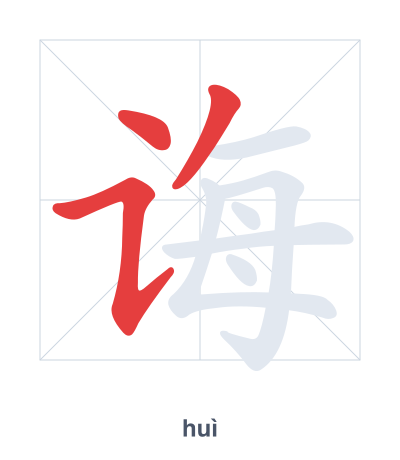
Open Hanzi Writer to see the animated stroke order and practice writing 诲 with real-time feedback.
The character 诲 (huì) is written with 9 strokes. Follow the standard Chinese stroke order: top to bottom, left to right, outside before inside. The radical 讠 is one of its key components.
Practice the correct stroke order with the Hanzi Writer app to see animated stroke-by-stroke guidance with real-time feedback.
诲 means to instruct.
诲 is a phono-semantic compound: the speech radical 讠 (words) indicates the act of speaking, while 每 (meaning 'every') provides phonetic hints. Together, they evoke the idea of instructing everyone through words.
💡 Memory Tip: Picture a speech bubble (讠) saying 'every' (每) as a teacher repeatedly tells each student the lesson, thus instructing.
我记住了老师的教诲。
wǒ jì zhù le lǎo shī de jiào huì
I remembered the teacher's teachings.
诲人是一件乐事。
huì rén shì yī jiàn lè shì
Teaching others is a joy.
父亲经常训诲我。
fù qīn jīng cháng xùn huì wǒ
My father often instructs me.
Open Hanzi Writer to see the animated stroke order and practice writing 诲 with real-time feedback.
✨ Animated stroke order · Handwriting recognition · HSK-graded practice · Free to use
诲 is composed of the radical 讠 (speech) on the left and 每 on the right. The speech radical shows that the character is related to spoken or written instruction, while 每 provides the sound huì and originally means "each" — as if teaching is done for each person individually.