缳 (huán) means "noose" in Chinese. It has 16 strokes with the radical 纟.
Rated 4.2/5 in difficulty (advanced).
Appears in 3+ common words including 缳套 (huán tào), 投缳 (tóu huán), 缳首 (huán shǒu).
Due to its 16 strokes, Hanzi Writer's error detection shows 缳 requires focused practice — most learners need 10+ attempts for consistent accuracy.
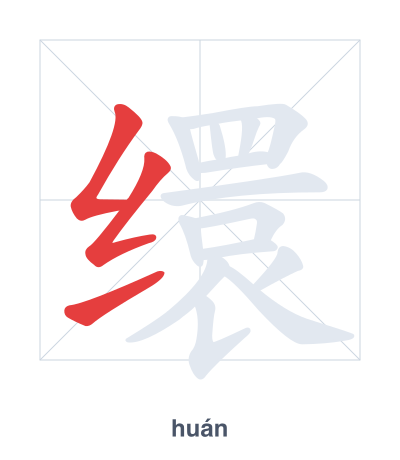
Open Hanzi Writer to see the animated stroke order and practice writing 缳 with real-time feedback.
The character 缳 (huán) is written with 16 strokes. Follow the standard Chinese stroke order: top to bottom, left to right, outside before inside. The radical 纟 is one of its key components.
Practice the correct stroke order with the Hanzi Writer app to see animated stroke-by-stroke guidance with real-time feedback.
缳 means noose.
This character is a phono-semantic compound. The silk radical (纟) indicates it relates to threads or rope, while 睘 (huán) provides the sound and also suggests a circular shape. Together they depict a rope loop, i.e., a noose.
💡 Memory Tip: Picture a silk thread (纟) forming a noose around a circular eye (睘) that stares wide with fear—it's ready to tighten.
绳子打了个缳套。
shéng zi dǎ le gè huán tào
The rope was tied into a loop.
这是一个古老的词。
zhè shì yí gè gǔ lǎo de cí
This is an ancient word.
这种刑罚叫缳首。
zhè zhǒng xíng fá jiào huán shǒu
This punishment is called strangulation.
Open Hanzi Writer to see the animated stroke order and practice writing 缳 with real-time feedback.
✨ Animated stroke order · Handwriting recognition · HSK-graded practice · Free to use
The left component 纟 (silk thread) indicates the character relates to rope or binding. The right component 睘 (huán, meaning to circle or return) suggests a loop shape, so together they form the idea of a looped rope — a noose.