蕻 (hóng) means "potherb mustard; lush" in Chinese. It has 16 strokes with the radical 艹.
Rated 4.2/5 in difficulty (advanced).
Appears in 3+ common words including 雪里蕻 (xuě lǐ hóng), 腌蕻 (yān hóng), 蕻菜 (hóng cài).
Due to its 16 strokes, Hanzi Writer's error detection shows 蕻 requires focused practice — most learners need 10+ attempts for consistent accuracy.
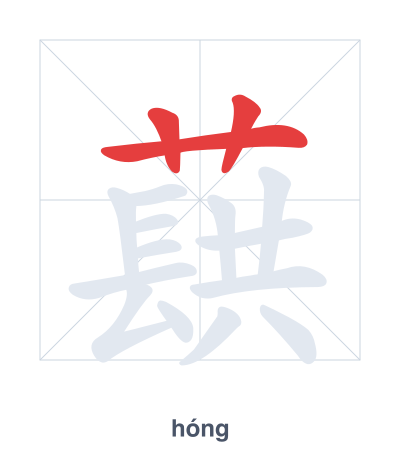
Open Hanzi Writer to see the animated stroke order and practice writing 蕻 with real-time feedback.
The character 蕻 (hóng) is written with 16 strokes. Follow the standard Chinese stroke order: top to bottom, left to right, outside before inside. The radical 艹 is one of its key components.
Practice the correct stroke order with the Hanzi Writer app to see animated stroke-by-stroke guidance with real-time feedback.
蕻 means potherb mustard; lush.
蕻 combines the grass radical (艹) with 洪 (hóng, meaning flood or torrent), suggesting plants that grow as abundantly as a flood, hence 'lush' or specifically a type of potherb mustard.
💡 Memory Tip: Imagine a torrent (洪) of green mustard leaves (艹) flooding a field, making it incredibly lush.
我喜欢吃雪里蕻。
wǒ xǐ huān chī xuě lǐ hóng
I like eating potherb mustard.
奶奶在腌蕻菜。
nǎi nǎi zài yān hóng cài
Grandma is pickling potherb mustard.
这种蕻菜很嫩。
zhè zhǒng hóng cài hěn nèn
This potherb mustard is very tender.
Open Hanzi Writer to see the animated stroke order and practice writing 蕻 with real-time feedback.
✨ Animated stroke order · Handwriting recognition · HSK-graded practice · Free to use
蕻 is composed of the radical 艹 (grass) on top and the phonetic component 洪 (hóng, meaning flood) below. The grass radical suggests it is a type of plant, while 洪 contributes the pronunciation and hints at a "lush" or "abundant" growth like a flood of greenery.