腌 (yān) means "To pickle / To salt / To cure" in Chinese. It has 12 strokes with the radical 月.
Rated 4.2/5 in difficulty (advanced).
Appears in 3+ common words including 腌制 (yān zhì), 腌菜 (yān cài), 腌肉 (yān ròu).
Due to its 12 strokes, Hanzi Writer's error detection shows 腌 requires focused practice — most learners need 10+ attempts for consistent accuracy.
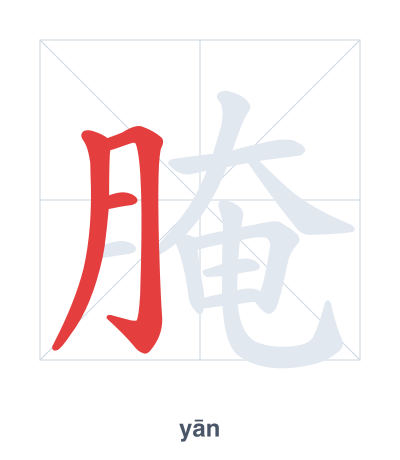
Open Hanzi Writer to see the animated stroke order and practice writing 腌 with real-time feedback.
The character 腌 (yān) is written with 12 strokes. Follow the standard Chinese stroke order: top to bottom, left to right, outside before inside. The radical 月 is one of its key components.
Practice the correct stroke order with the Hanzi Writer app to see animated stroke-by-stroke guidance with real-time feedback.
腌 means To pickle / To salt / To cure.
腌 is a phono-semantic compound. The radical 月 (meat/flesh) indicates the character relates to meat or food, while 奄 (yǎn) provides the sound and subtly suggests covering or preserving, as the process involves covering food with salt. Thus, 腌 literally means 'to salt or pickle meat.'
💡 Memory Tip: Picture a big (大) piece of meat (月) stretched out (申) and covered in salt to pickle it.
妈妈在腌制黄瓜。
mā mā zài yān zhì huáng guā
Mom is pickling cucumbers.
我喜欢吃腌菜。
wǒ xǐ huān chī yān cài
I like eating pickled vegetables.
腌肉的味道很咸。
yān ròu de wèi dào hěn xián
Salted meat tastes very salty.
Open Hanzi Writer to see the animated stroke order and practice writing 腌 with real-time feedback.
✨ Animated stroke order · Handwriting recognition · HSK-graded practice · Free to use
The character 腌 has the radical 月 (meat/flesh) on the left, and the component 奄 (yǎn, meaning "to cover" or "to conceal") on the right. Together, they suggest covering meat with salt to preserve it, which is the process of pickling or curing.