薨 (hōng) means "To pass away (of royalty or nobility)" in Chinese. It has 16 strokes with the radical 艹.
Rated 4.2/5 in difficulty (advanced).
Appears in 3+ common words including 薨逝 (hōng shì), 薨落 (hōng luò), 薨谢 (hōng xiè).
Due to its 16 strokes, Hanzi Writer's error detection shows 薨 requires focused practice — most learners need 10+ attempts for consistent accuracy.
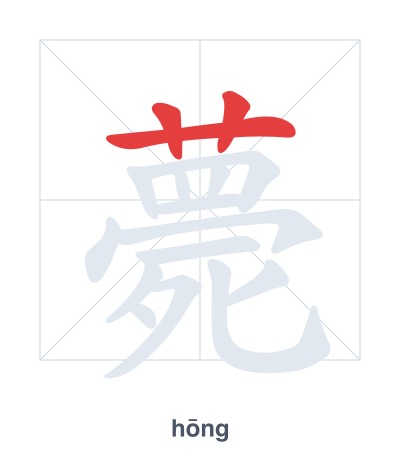
Open Hanzi Writer to see the animated stroke order and practice writing 薨 with real-time feedback.
The character 薨 (hōng) is written with 16 strokes. Follow the standard Chinese stroke order: top to bottom, left to right, outside before inside. The radical 艹 is one of its key components.
Practice the correct stroke order with the Hanzi Writer app to see animated stroke-by-stroke guidance with real-time feedback.
薨 means To pass away (of royalty or nobility).
The character 薨 combines the 'grass' radical (艹) with the phonetic component 夢 (dream). The grass radical may symbolize the covering of a noble's burial mound, while the pronunciation comes from 夢, reflecting the idea of a final sleep for royalty.
💡 Memory Tip: Imagine a noble (夢, dream) lying peacefully under a grassy cover (艹), having passed away into eternal rest.
那位王公不幸薨逝了。
nà wèi wáng gōng bù xìng hōng shì le
That prince unfortunately passed away.
星辰在夜空中薨落。
xīng chén zài yè kōng zhōng hōng luò
Stars fall in the night sky.
他在去年薨谢了。
tā zài qù nián hōng xiè le
He passed away last year.
Open Hanzi Writer to see the animated stroke order and practice writing 薨 with real-time feedback.
✨ Animated stroke order · Handwriting recognition · HSK-graded practice · Free to use
The character 薨 has the grass radical 艹 on top and the component 夢 (dream) below. While the grass radical often relates to plants, here it may suggest the fading of life, and 夢 hints at a noble's passing as if ending a dream. The exact etymology is uncertain, but the structure visually combines these ideas.