阚 (hǎn) means "to look; a surname" in Chinese. It has 14 strokes with the radical 门.
Rated 4.2/5 in difficulty (advanced).
Appears in 3+ common words including 阚先生 (hǎn xiān shēng), 阚姓 (hǎn xìng), 俯阚 (fǔ hǎn).
Due to its 14 strokes, Hanzi Writer's error detection shows 阚 requires focused practice — most learners need 10+ attempts for consistent accuracy.
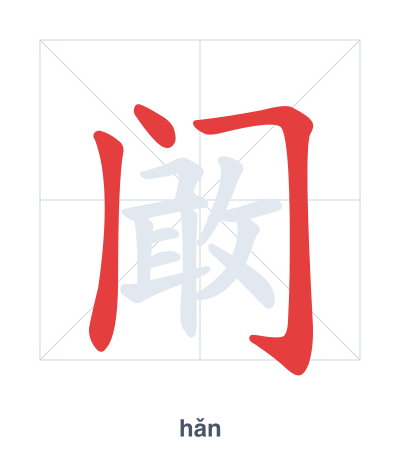
Open Hanzi Writer to see the animated stroke order and practice writing 阚 with real-time feedback.
The character 阚 (hǎn) is written with 14 strokes. Follow the standard Chinese stroke order: top to bottom, left to right, outside before inside. The radical 门 is one of its key components.
Practice the correct stroke order with the Hanzi Writer app to see animated stroke-by-stroke guidance with real-time feedback.
阚 means to look; a surname.
阚 combines the radical 门 (gate) with 敢 (dare). The gate represents an opening to look through, while 敢 suggests a bold or daring glance—hence the meaning 'to look' or 'to peer'. It also serves as a Chinese surname.
💡 Memory Tip: Picture a daring person peeking through a gate (门) with wide eyes (敢), boldly looking for something hidden.
阚先生是我的老师。
hǎn xiān shēng shì wǒ de lǎo shī
Mr. Kan is my teacher.
阚姓是一个姓氏。
hǎn xìng shì yí gè xìng shì
Kan is a surname.
登高俯阚全城。
dēng gāo fǔ hǎn quán chéng
Climb high to look down over the whole city.
Open Hanzi Writer to see the animated stroke order and practice writing 阚 with real-time feedback.
✨ Animated stroke order · Handwriting recognition · HSK-graded practice · Free to use
The character 阚 is formed by the radical 门 (door/gate) on the outside and the character 敢 (daring) inside. The door radical suggests a viewpoint or opening, and the daring component implies a bold way of looking, which connects to the meaning 'to look' or 'to overlook'.