掼 (guàn) means "to throw down; to fling; to slam" in Chinese. It has 11 strokes with the radical 扌.
Rated 4.2/5 in difficulty (advanced).
Appears in 3+ common words including 掼蛋 (guàn dàn), 掼在地上 (guàn zài dì shàng), 摔掼 (shuāi guàn).
Due to its 11 strokes, Hanzi Writer's error detection shows 掼 requires focused practice — most learners need 10+ attempts for consistent accuracy.
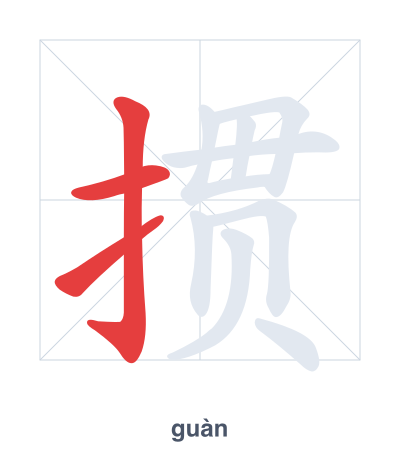
Open Hanzi Writer to see the animated stroke order and practice writing 掼 with real-time feedback.
The character 掼 (guàn) is written with 11 strokes. Follow the standard Chinese stroke order: top to bottom, left to right, outside before inside. The radical 扌 is one of its key components.
Practice the correct stroke order with the Hanzi Writer app to see animated stroke-by-stroke guidance with real-time feedback.
掼 means to throw down; to fling; to slam.
The character 掼 combines the hand radical (扌) with 贯, which originally depicted a string of coins passing through a hole. Together, they convey the idea of using one's hand to fling or slam something downward with such force that it seems to pierce or pass through a surface.
💡 Memory Tip: Imagine a hand (扌) flinging a string of coins (贯) down onto a table with a loud slam.
他们在玩掼蛋。
tā men zài wán guàn dàn
They are playing Guandan (a card game).
把书掼在地上。
bǎ shū guàn zài dì shàng
Throw the book onto the ground.
别到处摔掼东西。
bié dào chù shuāi guàn dōng xī
Don't throw things around.
Open Hanzi Writer to see the animated stroke order and practice writing 掼 with real-time feedback.
✨ Animated stroke order · Handwriting recognition · HSK-graded practice · Free to use
掼 is made of the radical 扌 (hand) on the left, and the phonetic component 贯 (guàn) on the right. The hand radical indicates an action done with the hand, like throwing or slamming. The right side 贯 originally means "to string through" but here mainly gives the pronunciation and reinforces the forceful action.