棺 (guān) means "Coffin" in Chinese. It has 12 strokes with the radical 木, and is HSK Level 7.
Rated 4.2/5 in difficulty (advanced).
Harder than 64% of HSK Level 7 characters.
Appears in 3+ common words including 棺材 (guān cái), 石棺 (shí guān), 灵棺 (líng guān).
Due to its 12 strokes, Hanzi Writer's error detection shows 棺 requires focused practice — most learners need 10+ attempts for consistent accuracy.
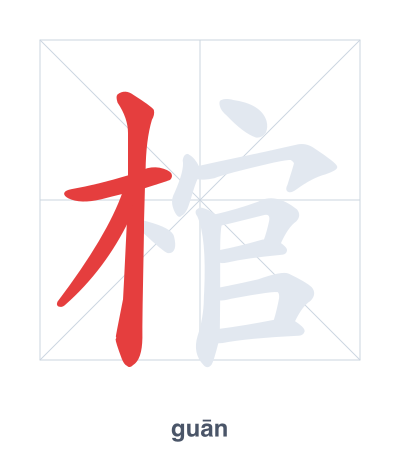
Open Hanzi Writer to see the animated stroke order and practice writing 棺 with real-time feedback.
The character 棺 (guān) is written with 12 strokes. Follow the standard Chinese stroke order: top to bottom, left to right, outside before inside. The radical 木 is one of its key components.
Practice the correct stroke order with the Hanzi Writer app to see animated stroke-by-stroke guidance with real-time feedback.
棺 means Coffin.
As an HSK Level 7 character, 棺 is an intermediate-level character.
This character is a phono-semantic compound: the radical 木 (wood) indicates the material used for coffins, while 官 (guān, official) provides the sound. Ancient Chinese coffins were typically made of wood, so the combination literally means 'wooden official' — a resting place for a person of status.
💡 Memory Tip: Picture a wooden box (木) with an official (官) lying inside — that's a coffin.
这是一个木头棺材。
zhè shì yí gè mù tou guān cái
This is a wooden coffin.
博物馆里有石棺。
bó wù guǎn lǐ yǒu shí guān
There are sarcophagi in the museum.
灵棺停在屋子中间。
líng guān tíng zài wū zi zhōng jiān
The coffin is placed in the middle of the room.
Open Hanzi Writer to see the animated stroke order and practice writing 棺 with real-time feedback.
✨ Animated stroke order · Handwriting recognition · HSK-graded practice · Free to use
棺 is made of the radical 木 (wood) on the left and the phonetic component 官 (guān) on the right. The wood radical shows that coffins were traditionally made of wood, while 官 gives the pronunciation and originally suggested the idea of an official's resting place.