材 (cái) means "Material; timber" in Chinese. It has 7 strokes with the radical 木, and is HSK Level 3.
Rated 3.5/5 in difficulty (challenging).
Harder than 41% of HSK Level 3 characters.
Appears in 3+ common words including 材料 (cái liào), 身材 (shēn cái), 木材 (mù cái).
Due to its 7 strokes, Hanzi Writer's error detection shows 材 requires focused practice — most learners need 10+ attempts for consistent accuracy.
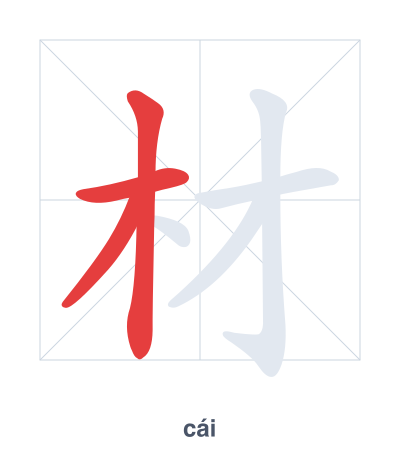
Open Hanzi Writer to see the animated stroke order and practice writing 材 with real-time feedback.
The character 材 (cái) is written with 7 strokes. Follow the standard Chinese stroke order: top to bottom, left to right, outside before inside. The radical 木 is one of its key components.
Practice the correct stroke order with the Hanzi Writer app to see animated stroke-by-stroke guidance with real-time feedback.
材 means Material; timber.
As an HSK Level 3 character, 材 is an intermediate-level character.
材 combines the radical 木 (tree/wood) with 才 (cái, talent), which provides the phonetic element. Together, they depict wood that is 'talented' or suitable for use as material or timber.
💡 Memory Tip: Imagine a talented tree (木) whose wood is perfect material for crafting, because its 'cai' (才) makes it the best timber.
请准备好申请材料。
qǐng zhǔn bèi hǎo shēn qǐng cái liào
Please prepare the application materials.
他的身材很匀称。
tā de shēn cái hěn yún chèn
His figure is very well-proportioned.
这些木材用来做桌子。
zhè xiē mù cái yòng lái zuò zhuō zi
This wood is used to make tables.
Open Hanzi Writer to see the animated stroke order and practice writing 材 with real-time feedback.
✨ Animated stroke order · Handwriting recognition · HSK-graded practice · Free to use
材 is composed of the radical 木 (wood/tree) on the left and the phonetic component 才 (cái) on the right. The wood radical directly reflects its meaning of timber or material, while 才 provides the pronunciation and adds the idea of ability or raw potential.