掴 (guāi) means "to slap" in Chinese. It has 11 strokes with the radical 扌.
Rated 4.2/5 in difficulty (advanced).
Appears in 3+ common words including 掴脸 (guāi liǎn), 掴耳光 (guāi ěr guāng), 掴一巴掌 (guāi yī bā zhǎng).
Due to its 11 strokes, Hanzi Writer's error detection shows 掴 requires focused practice — most learners need 10+ attempts for consistent accuracy.
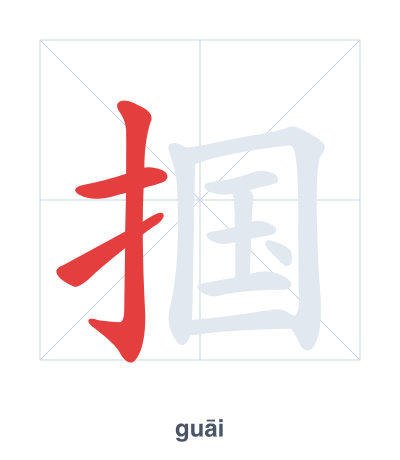
Open Hanzi Writer to see the animated stroke order and practice writing 掴 with real-time feedback.
The character 掴 (guāi) is written with 11 strokes. Follow the standard Chinese stroke order: top to bottom, left to right, outside before inside. The radical 扌 is one of its key components.
Practice the correct stroke order with the Hanzi Writer app to see animated stroke-by-stroke guidance with real-time feedback.
掴 means to slap.
掴 is a phono-semantic compound. The left radical 扌 (hand) indicates the action of slapping, while the right component 国 (country) originally provided the sound in the traditional form 摑. Together, they suggest a hand striking something, like a slap across a face.
💡 Memory Tip: Imagine your hand (扌) slapping a round face shaped like a country (国) on a map, making a loud 'guāi' sound.
他掴了那人一脸。
tā guāi le nà rén yī liǎn
He slapped that person's face.
她打了一个掴耳光。
tā dǎ le yí gè guāi ěr guāng
She gave a slap across the face.
狠狠地掴一巴掌。
hěn hěn dì guāi yī bā zhǎng
To give a hard slap.
Open Hanzi Writer to see the animated stroke order and practice writing 掴 with real-time feedback.
✨ Animated stroke order · Handwriting recognition · HSK-graded practice · Free to use
The left side is the radical 扌, which means "hand" and shows that this character involves a hand action. The right side is 国 (country), which gives a phonetic hint for the pronunciation guāi, but does not directly relate to the meaning. Together, the hand radical and the sound component create a character for "to slap."