嘏 (gǔ) means "Good fortune / Longevity" in Chinese. It has 14 strokes with the radical 口.
Rated 3.9/5 in difficulty (challenging).
Appears in 3+ common words including 祝嘏 (zhù gǔ), 嘏辞 (gǔ cí), 嘏福 (gǔ fú).
Due to its 14 strokes, Hanzi Writer's error detection shows 嘏 requires focused practice — most learners need 10+ attempts for consistent accuracy.
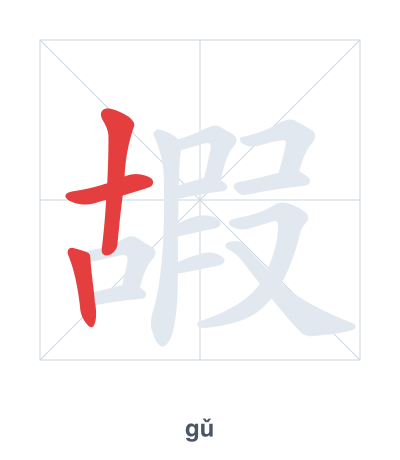
Open Hanzi Writer to see the animated stroke order and practice writing 嘏 with real-time feedback.
The character 嘏 (gǔ) is written with 14 strokes. Follow the standard Chinese stroke order: top to bottom, left to right, outside before inside. The radical 口 is one of its key components.
Practice the correct stroke order with the Hanzi Writer app to see animated stroke-by-stroke guidance with real-time feedback.
嘏 means Good fortune / Longevity.
嘏 combines 口 (mouth, for uttering blessings) with 古 (ancient, implying ancestral tradition) and 殳 (a hand holding a rod, a ritual tool associated with authority and blessing). Together, the character visually depicts speaking ancient blessings with ritual authority, conveying the meaning of good fortune and longevity.
💡 Memory Tip: At the mouth of an ancient temple, a hand with a rod (殳) bestows the blessing of long life.
大家为他祝嘏。
dà jiā wèi tā zhù gǔ
Everyone offered him birthday wishes.
这是祝寿的嘏辞。
zhè shì zhù shòu de gǔ cí
This is a congratulatory speech for a birthday.
祝你享大嘏福。
zhù nǐ xiǎng dà gǔ fú
Wish you great blessings and longevity.
Open Hanzi Writer to see the animated stroke order and practice writing 嘏 with real-time feedback.
✨ Animated stroke order · Handwriting recognition · HSK-graded practice · Free to use
The character 嘏 has a left-right structure, with the radical 口 (mouth) on the left and the more complex component 古 (gǔ, ancient) on the right. The 口 radical relates to speech or blessings spoken aloud, while 古 suggests something old or enduring, together conveying "ancient blessings" or long-lasting good fortune, which aligns with its meaning of longevity and great fortune.