咕 (gū) means "coo; rumble (onomatopoeia)" in Chinese. It has 8 strokes with the radical 口.
Rated 3.7/5 in difficulty (challenging).
Appears in 3+ common words including 咕噜 (gū lū), 咕嘟 (gū dū), 咕哝 (gū nóng).
Due to its 8 strokes, Hanzi Writer's error detection shows 咕 requires focused practice — most learners need 10+ attempts for consistent accuracy.
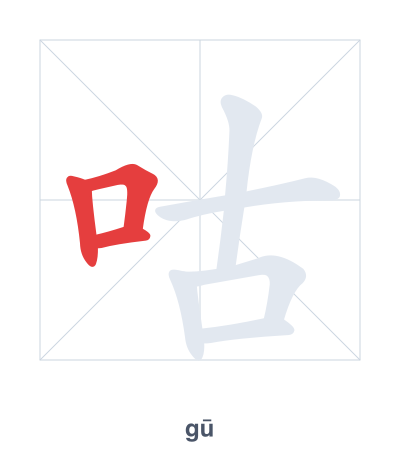
Open Hanzi Writer to see the animated stroke order and practice writing 咕 with real-time feedback.
The character 咕 (gū) is written with 8 strokes. Follow the standard Chinese stroke order: top to bottom, left to right, outside before inside. The radical 口 is one of its key components.
Practice the correct stroke order with the Hanzi Writer app to see animated stroke-by-stroke guidance with real-time feedback.
咕 means coo; rumble (onomatopoeia).
咕 is a compound character with the mouth radical (口) indicating sound and 古 (gǔ) serving as a phonetic component. It depicts noises like a pigeon's coo or a stomach's rumble through the combination of a speaking mouth and the sound hint 'gu'.
💡 Memory Tip: Picture a chalk-white ancient (古) mouth (口) opening wide to let out a soft 'coo-coo' like a pigeon.
肚子咕噜咕噜叫。
dǔ zi gū lū gū lū jiào
My stomach is growling.
水在锅里咕嘟响。
shuǐ zài guō lǐ gū dū xiǎng
The water is bubbling in the pot.
他在小声咕哝。
tā zài xiǎo shēng gū nóng
He is muttering under his breath.
Open Hanzi Writer to see the animated stroke order and practice writing 咕 with real-time feedback.
✨ Animated stroke order · Handwriting recognition · HSK-graded practice · Free to use
咕 is made of the radical 口 (mouth) on the left and 古 (gǔ, ancient) on the right. The mouth radical suggests sound or speech, while 古 provides pronunciation. Together they create an onomatopoeic character for cooing or rumbling sounds made by the mouth or stomach.