鳄 (è) means "crocodile" in Chinese. It has 17 strokes with the radical 鱼, and is HSK Level 7.
Rated 4.2/5 in difficulty (advanced).
Harder than 99% of HSK Level 7 characters.
Appears in 3+ common words including 鳄鱼 (è yú), 鳄鱼皮 (è yú pí), 小鳄鱼 (xiǎo è yú).
Due to its 17 strokes, Hanzi Writer's error detection shows 鳄 requires focused practice — most learners need 10+ attempts for consistent accuracy.
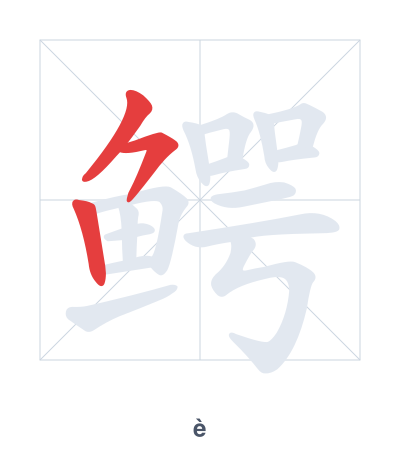
Open Hanzi Writer to see the animated stroke order and practice writing 鳄 with real-time feedback.
The character 鳄 (è) is written with 17 strokes. Follow the standard Chinese stroke order: top to bottom, left to right, outside before inside. The radical 鱼 is one of its key components.
Practice the correct stroke order with the Hanzi Writer app to see animated stroke-by-stroke guidance with real-time feedback.
鳄 means crocodile.
As an HSK Level 7 character, 鳄 is an intermediate-level character.
鳄 is a phono-semantic compound. The radical 鱼 (fish) indicates it's an aquatic creature, while 咢 (è) provides the pronunciation and also suggests a snapping jaw. Together, they depict a crocodile's fish-like aquatic habitat and its powerful jaws.
💡 Memory Tip: Imagine a fish (鱼) with an enormous open mouth (咢) full of jagged teeth—that's a crocodile.
动物园里有鳄鱼。
dòng wù yuán lǐ yǒu è yú
There are crocodiles in the zoo.
鳄鱼皮很硬。
è yú pí hěn yìng
Crocodile skin is very hard.
小鳄鱼真可爱。
xiǎo è yú zhēn kě ài
The baby crocodile is so cute.
Open Hanzi Writer to see the animated stroke order and practice writing 鳄 with real-time feedback.
✨ Animated stroke order · Handwriting recognition · HSK-graded practice · Free to use
鳄 is made of two parts: the left radical 鱼 (fish/animal from water) and the right component 咢 (è, which gives the sound). Together, 鱼 tells you this character is an aquatic creature, while 咢 provides the pronunciation. This structure shows 鳄 is a phono-semantic compound meaning "crocodile."