鲇 (nián) means "Catfish" in Chinese. It has 13 strokes with the radical 鱼.
Rated 4.2/5 in difficulty (advanced).
Appears in 3+ common words including 鲇鱼 (nián yú), 鲇鱼汤 (nián yú tāng), 大鲇鱼 (dà nián yú).
Due to its 13 strokes, Hanzi Writer's error detection shows 鲇 requires focused practice — most learners need 10+ attempts for consistent accuracy.
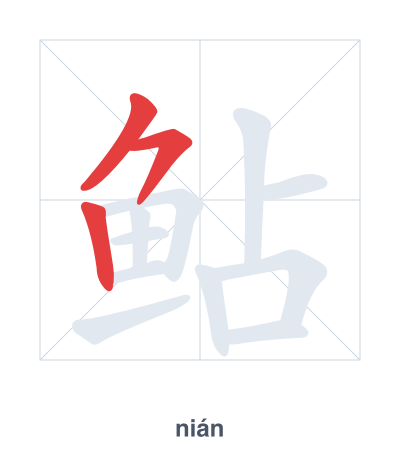
Open Hanzi Writer to see the animated stroke order and practice writing 鲇 with real-time feedback.
The character 鲇 (nián) is written with 13 strokes. Follow the standard Chinese stroke order: top to bottom, left to right, outside before inside. The radical 鱼 is one of its key components.
Practice the correct stroke order with the Hanzi Writer app to see animated stroke-by-stroke guidance with real-time feedback.
鲇 means Catfish.
鲇 is a semantic-phonetic compound: the radical 鱼 (fish) indicates the meaning, while 占 (zhàn, 'to occupy') originally served as a phonetic component, though the pronunciation shifted to nián over time. This character refers to the catfish, a common freshwater fish known for its whisker-like barbels.
💡 Memory Tip: Picture a catfish (鱼) using its barbels to trace the shape of 占 on the muddy riverbed, marking its occupied territory.
鲇鱼喜欢住在泥里。
nián yú xǐ huān zhù zài ní lǐ
Catfish like to live in the mud.
鲇鱼汤非常有营养。
nián yú tāng fēi cháng yǒu yíng yǎng
Catfish soup is very nutritious.
他钓到了一条大鲇鱼。
tā diào dào le yī tiáo dà nián yú
He caught a large catfish.
Open Hanzi Writer to see the animated stroke order and practice writing 鲇 with real-time feedback.
✨ Animated stroke order · Handwriting recognition · HSK-graded practice · Free to use
The character 鲇 is made of two parts: the left side is 鱼 (fish radical), which tells you the character refers to a type of fish. The right side is 占, which originally was a phonetic hint but in modern Mandarin does not match the sound nián, so it mainly helps distinguish the character visually.