鲅 (bà) means "Mackerel" in Chinese. It has 13 strokes with the radical 鱼.
Rated 4.2/5 in difficulty (advanced).
Appears in 3+ common words including 鲅鱼 (bà yú), 鲅鱼饺子 (bà yú jiǎo zi), 熏鲅鱼 (xūn bà yú).
Due to its 13 strokes, Hanzi Writer's error detection shows 鲅 requires focused practice — most learners need 10+ attempts for consistent accuracy.
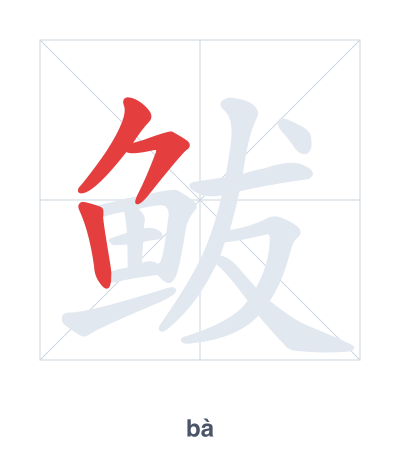
Open Hanzi Writer to see the animated stroke order and practice writing 鲅 with real-time feedback.
The character 鲅 (bà) is written with 13 strokes. Follow the standard Chinese stroke order: top to bottom, left to right, outside before inside. The radical 鱼 is one of its key components.
Practice the correct stroke order with the Hanzi Writer app to see animated stroke-by-stroke guidance with real-time feedback.
鲅 means Mackerel.
The character 鲅 is a phono-semantic compound: the left radical 鱼 (fish) indicates it is a type of fish, while the right component 犮 (bá) provides the pronunciation. Mackerel are swift, predatory fish, and the component 犮 originally depicted a dog pulling or drawing something, hinting at the mackerel's active, darting movement.
💡 Memory Tip: Picture a fish (鱼) that's so fast it looks like a dog (犮) chasing its own tail, leaving a trail of mackerel behind.
今天的鲅鱼很新鲜。
jīn tiān de bà yú hěn xīn xiān
Today's mackerel is very fresh.
我最爱吃鲅鱼饺子。
wǒ zuì ài chī bà yú jiǎo zi
I love eating Spanish mackerel dumplings the most.
熏鲅鱼的味道很香。
xūn bà yú de wèi dào hěn xiāng
Smoked Spanish mackerel smells delicious.
Open Hanzi Writer to see the animated stroke order and practice writing 鲅 with real-time feedback.
✨ Animated stroke order · Handwriting recognition · HSK-graded practice · Free to use
鲅 is made of two parts: the left side 鱼 (fish) and the right side 犮 (bá, which gives the sound). The 鱼 radical tells you that 鲅 is a type of fish, while 犮 provides the pronunciation but does not add meaning. So the structure shows it is a fish called mackerel.