鲆 (píng) means "Flatfish" in Chinese. It has 13 strokes with the radical 鱼.
Rated 4.2/5 in difficulty (advanced).
Appears in 3+ common words including 鲆鱼 (píng yú), 牙鲆 (yá píng), 煎鲆鱼 (jiān píng yú).
Due to its 13 strokes, Hanzi Writer's error detection shows 鲆 requires focused practice — most learners need 10+ attempts for consistent accuracy.
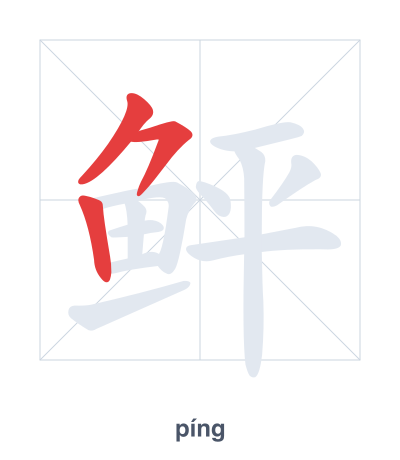
Open Hanzi Writer to see the animated stroke order and practice writing 鲆 with real-time feedback.
The character 鲆 (píng) is written with 13 strokes. Follow the standard Chinese stroke order: top to bottom, left to right, outside before inside. The radical 鱼 is one of its key components.
Practice the correct stroke order with the Hanzi Writer app to see animated stroke-by-stroke guidance with real-time feedback.
鲆 means Flatfish.
鲆 is a semantic-phonetic compound: the radical 鱼 (fish) indicates it's a type of fish, and the phonetic component 平 (píng) hints at its meaning 'flat' — flatfish are notably flattened sideways.
💡 Memory Tip: Picture a fish (鱼) lying flat (平) on a plate, as if it's been pressed into a pancake.
鲆鱼的身体是扁的。
píng yú de shēn tǐ shì biǎn de
The body of a flatfish is flat.
牙鲆是一种名贵的海鱼。
yá píng shì yī zhǒng míng guì de hǎi yú
The olive flounder is a precious sea fish.
晚餐我们吃煎鲆鱼。
wǎn cān wǒ men chī jiān píng yú
We are having pan-fried flatfish for dinner.
Open Hanzi Writer to see the animated stroke order and practice writing 鲆 with real-time feedback.
✨ Animated stroke order · Handwriting recognition · HSK-graded practice · Free to use
鲆 is made of the radical 鱼 (fish) on the left and 平 (píng, meaning flat) on the right. Together they show a fish that is flat in shape, which is exactly what a flatfish or flounder is.