阇 (dū) means "tower over a city gate; Buddhist monk" in Chinese. It has 11 strokes with the radical 门.
Rated 4.2/5 in difficulty (advanced).
Appears in 3+ common words including 阇黎 (dū lí), 阇王 (dū wáng), 阿阇黎 (ā dū lí).
Due to its 11 strokes, Hanzi Writer's error detection shows 阇 requires focused practice — most learners need 10+ attempts for consistent accuracy.
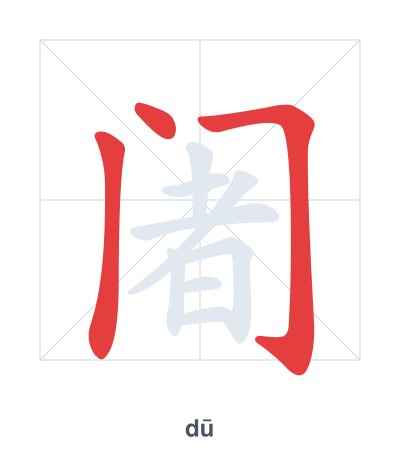
Open Hanzi Writer to see the animated stroke order and practice writing 阇 with real-time feedback.
The character 阇 (dū) is written with 11 strokes. Follow the standard Chinese stroke order: top to bottom, left to right, outside before inside. The radical 门 is one of its key components.
Practice the correct stroke order with the Hanzi Writer app to see animated stroke-by-stroke guidance with real-time feedback.
阇 means tower over a city gate; Buddhist monk.
阇 is a phono-semantic compound with the radical 门 (gate) and the phonetic component 者 (zhě), originally depicting a watchtower above a city gate. Later, it was borrowed to transliterate Buddhist terms for a teacher or monk, such as in '阿阇梨' (āśāri).
💡 Memory Tip: Picture a Buddhist monk (者) standing on a tower (阇) above the city gate (门), preaching to the crowd below.
那位阇黎在寺庙里修行。
nà wèi dū lí zài sì miào lǐ xiū xíng
That Buddhist master is practicing in the temple.
书里提到了阇王的故事。
shū lǐ tí dào le dū wáng de gù shì
The story of King Ajatashatru is mentioned in the book.
他是大家尊敬的阿阇黎。
tā shì dà jiā zūn jìng de ā dū lí
He is a respected Acharya.
Open Hanzi Writer to see the animated stroke order and practice writing 阇 with real-time feedback.
✨ Animated stroke order · Handwriting recognition · HSK-graded practice · Free to use
The character 阇 has the radical 门 (gate/door) on the outside, which hints at the meaning of a tower over a city gate. Inside is 者 (zhě), which gives the character its pronunciation dū and adds the association with a Buddhist monk, likely through phonetic borrowing. Together, 门 and 者 form a phono-semantic compound combining the idea of a gate structure with the sound dū.