淀 (diàn) means "Starch / sediment" in Chinese. It has 11 strokes with the radical 氵, and is HSK Level 7.
Rated 4.2/5 in difficulty (advanced).
Harder than 67% of HSK Level 7 characters.
Appears in 3+ common words including 淀粉 (diàn fěn), 沉淀 (chén diàn), 海淀 (hǎi diàn).
Due to its 11 strokes, Hanzi Writer's error detection shows 淀 requires focused practice — most learners need 10+ attempts for consistent accuracy.
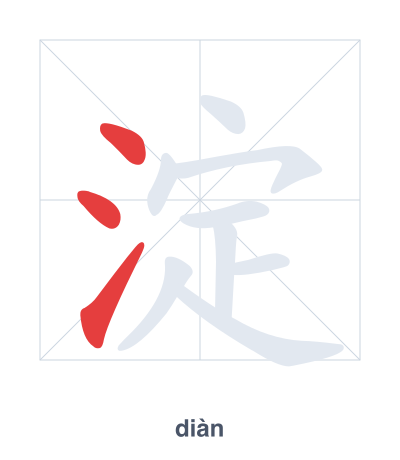
Open Hanzi Writer to see the animated stroke order and practice writing 淀 with real-time feedback.
The character 淀 (diàn) is written with 11 strokes. Follow the standard Chinese stroke order: top to bottom, left to right, outside before inside. The radical 氵 is one of its key components.
Practice the correct stroke order with the Hanzi Writer app to see animated stroke-by-stroke guidance with real-time feedback.
淀 means Starch / sediment.
As an HSK Level 7 character, 淀 is an intermediate-level character.
淀 is a compound of 氵 (water) and 定 (fixed/stable). The idea is that when water is still, fine particles settle and become fixed at the bottom, forming sediment or starch.
💡 Memory Tip: Imagine starch settling in still water, with the '定' part showing it's fixed at the bottom like a solid deposit.
土豆里含有大量淀粉。
tǔ dòu lǐ hán yǒu dà liàng diàn fěn
Potatoes contain a large amount of starch.
杯底有一些白色沉淀。
bēi dǐ yǒu yī xiē bái sè chén diàn
There is some white sediment at the bottom of the cup.
他在北京海淀区工作。
tā zài běi jīng hǎi diàn qū gōng zuò
He works in Haidian District, Beijing.
Open Hanzi Writer to see the animated stroke order and practice writing 淀 with real-time feedback.
✨ Animated stroke order · Handwriting recognition · HSK-graded practice · Free to use
The left side is the radical 氵 (water), indicating the character relates to liquids. The right side is 定 (dìng, meaning 'fixed' or 'settled'), suggesting solid particles settling down in water. Together, they form the idea of sediment settling in liquid, which is also the source of starch.