涤 (dí) means "to wash; to cleanse" in Chinese. It has 10 strokes with the radical 氵, and is HSK Level 7.
Rated 4.2/5 in difficulty (advanced).
Harder than 66% of HSK Level 7 characters.
Appears in 3+ common words including 洗涤 (xǐ dí), 涤荡 (dí dàng), 洗涤剂 (xǐ dí jì).
Due to its 10 strokes, Hanzi Writer's error detection shows 涤 requires focused practice — most learners need 10+ attempts for consistent accuracy.
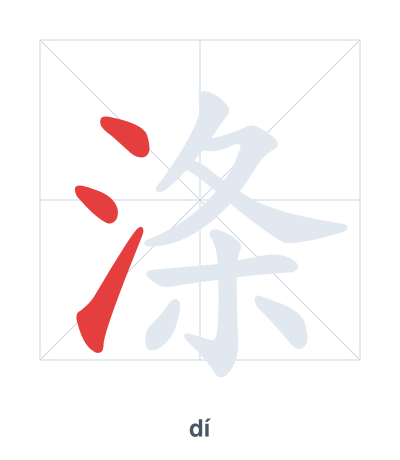
Open Hanzi Writer to see the animated stroke order and practice writing 涤 with real-time feedback.
The character 涤 (dí) is written with 10 strokes. Follow the standard Chinese stroke order: top to bottom, left to right, outside before inside. The radical 氵 is one of its key components.
Practice the correct stroke order with the Hanzi Writer app to see animated stroke-by-stroke guidance with real-time feedback.
涤 means to wash; to cleanse.
As an HSK Level 7 character, 涤 is an intermediate-level character.
涤 is a compound character combining the water radical 氵 (representing liquid) with 条 (tiáo, meaning 'strip' or 'long narrow piece'), originally depicting washing a strip of cloth. In its traditional form 滌, the right component 條 also suggests the idea of cleaning by rubbing or rinsing a long fabric. The visual thus connects water with a strip being cleansed.
💡 Memory Tip: Picture a long, dirty strip of cloth (条) being vigorously scrubbed in water (氵) until it's spotless.
这件衣服需要洗涤。
zhè jiàn yī fú xū yào xǐ dí
This clothing needs to be washed.
雨水涤荡了灰尘。
yǔ shuǐ dí dàng le huī chén
The rain washed away the dust.
请用洗涤剂洗碗。
qǐng yòng xǐ dí jì xǐ wǎn
Please use detergent to wash the dishes.
Open Hanzi Writer to see the animated stroke order and practice writing 涤 with real-time feedback.
✨ Animated stroke order · Handwriting recognition · HSK-graded practice · Free to use
The left part 氵 is the water radical, showing that washing involves water. The right part 条 (tiáo) originally meant a strip of silk but here provides sound and hints at the action of cleaning. Together, 涤 means to wash or cleanse with water.