荡 (dàng) means "To swing; to sway; to ripple" in Chinese. It has 9 strokes with the radical 艹, and is HSK Level 7.
Rated 4/5 in difficulty (challenging).
Harder than 45% of HSK Level 7 characters.
Appears in 3+ common words including 荡秋千 (dàng qiū qiān), 动荡 (dòng dàng), 游荡 (yóu dàng).
Due to its 9 strokes, Hanzi Writer's error detection shows 荡 requires focused practice — most learners need 10+ attempts for consistent accuracy.
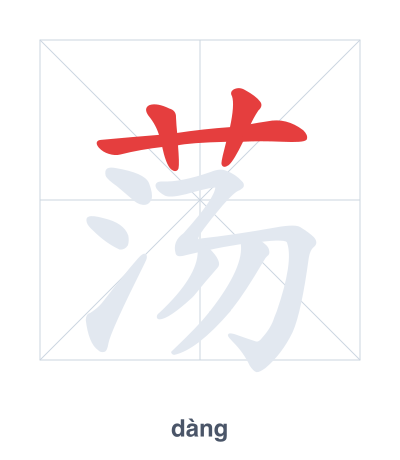
Open Hanzi Writer to see the animated stroke order and practice writing 荡 with real-time feedback.
The character 荡 (dàng) is written with 9 strokes. Follow the standard Chinese stroke order: top to bottom, left to right, outside before inside. The radical 艹 is one of its key components.
Practice the correct stroke order with the Hanzi Writer app to see animated stroke-by-stroke guidance with real-time feedback.
荡 means To swing; to sway; to ripple.
As an HSK Level 7 character, 荡 is an intermediate-level character.
荡 combines the radical 艹 (grass) and the phonetic component 汤 (tāng, 'soup' or 'hot water'), which also hints at water. Grass swaying in the wind or water rippling visually connects to the meaning of swinging and swaying.
💡 Memory Tip: Picture grass (艹) swaying over a bowl of hot soup (汤), causing ripples and swinging movements.
小孩子喜欢荡秋千。
xiǎo hái zi xǐ huān dàng qiū qiān
Children like to play on the swings.
那里的局势很动荡。
nà lǐ de jú shì hěn dòng dàng
The situation there is very unstable.
他在街上闲着游荡。
tā zài jiē shàng xián zhe yóu dàng
He is wandering aimlessly on the street.
Open Hanzi Writer to see the animated stroke order and practice writing 荡 with real-time feedback.
✨ Animated stroke order · Handwriting recognition · HSK-graded practice · Free to use
The character 荡 has the grass radical 艹 on top and 汤 (soup) below. The grass radical can suggest plants swaying, while 汤 hints at ripples in water. Together they create the idea of gentle, flowing movement like swinging or rippling.