嘚 (dē) means "(Onomatopoeia) Clip-clop / (Dialect) To chatter" in Chinese. It has 14 strokes with the radical 口.
Rated 4.2/5 in difficulty (advanced).
Appears in 3+ common words including 嘚瑟 (dē sè), 嘚嘚 (dē dē), 嘚啵 (dē bō).
Due to its 14 strokes, Hanzi Writer's error detection shows 嘚 requires focused practice — most learners need 10+ attempts for consistent accuracy.
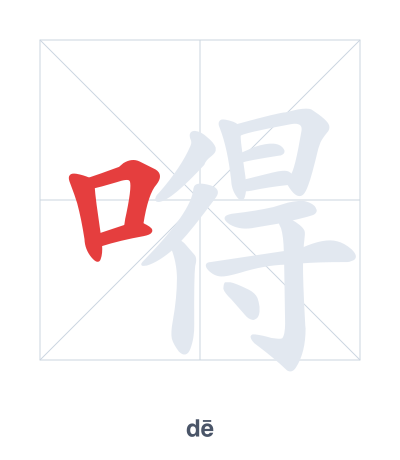
Open Hanzi Writer to see the animated stroke order and practice writing 嘚 with real-time feedback.
The character 嘚 (dē) is written with 14 strokes. Follow the standard Chinese stroke order: top to bottom, left to right, outside before inside. The radical 口 is one of its key components.
Practice the correct stroke order with the Hanzi Writer app to see animated stroke-by-stroke guidance with real-time feedback.
嘚 means (Onomatopoeia) Clip-clop / (Dialect) To chatter.
嘚 is a phono-semantic compound: the mouth radical 口 indicates sound or speech, while 得 (dé) provides the pronunciation and adds a hint of 'getting' or 'obtaining' — as in the sound of horse hooves getting closer or a person getting into a chatter. The character originally depicts the clip-clop of hooves or, in dialect, the repetitive noise of chattering.
💡 Memory Tip: Picture a horse's mouth (口) going 'dē-dē-dē' as it clip-clops along, while the right side 得 looks like a rider getting the horse to go faster.
你别在那儿嘚瑟。
nǐ bié zài nà ér dē sè
Stop showing off over there.
马蹄声嘚嘚响。
mǎ tí shēng dē dē xiǎng
The horse hooves are trotting.
他一直在嘚啵。
tā yì zhí zài dē bō
He has been babbling on and on.
Open Hanzi Writer to see the animated stroke order and practice writing 嘚 with real-time feedback.
✨ Animated stroke order · Handwriting recognition · HSK-graded practice · Free to use
嘚 is made of the radical 口 (mouth) on the left and the phonetic component 得 (dé) on the right. The mouth radical indicates that the character relates to sounds or speech, like the clip-clop of horse hooves or chattering talk. The right part 得 provides the pronunciation "dē" and does not directly contribute to the meaning.