啵 (bō) means "(onomatopoeia) pop; kiss" in Chinese. It has 11 strokes with the radical 口.
Rated 4.2/5 in difficulty (advanced).
Appears in 3+ common words including 啵一个 (bō yí gè), 啵啵 (bō bō), 亲啵 (qīn bō).
Due to its 11 strokes, Hanzi Writer's error detection shows 啵 requires focused practice — most learners need 10+ attempts for consistent accuracy.
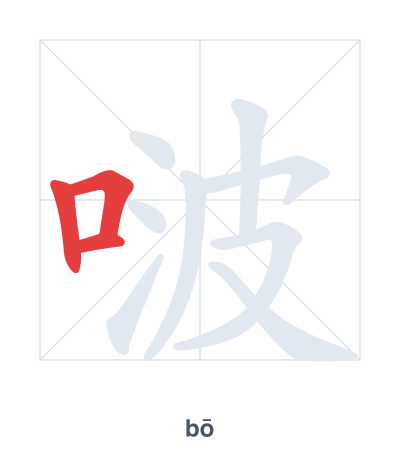
Open Hanzi Writer to see the animated stroke order and practice writing 啵 with real-time feedback.
The character 啵 (bō) is written with 11 strokes. Follow the standard Chinese stroke order: top to bottom, left to right, outside before inside. The radical 口 is one of its key components.
Practice the correct stroke order with the Hanzi Writer app to see animated stroke-by-stroke guidance with real-time feedback.
啵 means (onomatopoeia) pop; kiss.
啵 is a phono-semantic compound: the mouth radical (口) indicates a sound produced by the mouth, while 波 (bō) provides the pronunciation and hints at a popping or rippling effect, like a kiss or a bubble bursting.
💡 Memory Tip: Imagine a mouth (口) making a 'pop' sound as it blows a wave (波) of bubbles, each bursting with a kiss.
妈妈啵一个。
mā mā bō yí gè
Mom gives a kiss.
鱼儿吐啵啵。
yú ér tǔ bō bō
The fish are blowing bubbles.
亲啵一下。
qīn bō yī xià
Give a little kiss.
Open Hanzi Writer to see the animated stroke order and practice writing 啵 with real-time feedback.
✨ Animated stroke order · Handwriting recognition · HSK-graded practice · Free to use
啵 is made of two parts: the left radical 口 (mouth) and the right part 波 (bō). The 口 shows it is a sound-related character, and 波 gives the pronunciation and suggests the 'popping' sound of bubbles or a kiss. Together they create an onomatopoeia for a light, crisp pop or a kiss sound.