瑟 (sè) means "se (a traditional Chinese zither)" in Chinese. It has 13 strokes with the radical 王.
Rated 3.9/5 in difficulty (challenging).
Appears in 3+ common words including 琴瑟 (qín sè), 瑟瑟 (sè sè), 瑟缩 (sè suō).
Due to its 13 strokes, Hanzi Writer's error detection shows 瑟 requires focused practice — most learners need 10+ attempts for consistent accuracy.
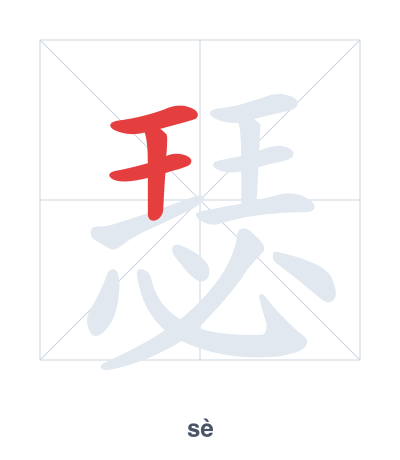
Open Hanzi Writer to see the animated stroke order and practice writing 瑟 with real-time feedback.
The character 瑟 (sè) is written with 13 strokes. Follow the standard Chinese stroke order: top to bottom, left to right, outside before inside. The radical 王 is one of its key components.
Practice the correct stroke order with the Hanzi Writer app to see animated stroke-by-stroke guidance with real-time feedback.
瑟 means se (a traditional Chinese zither).
瑟 combines the radical 王 (a variant of 玉, meaning 'jade') with the phonetic component 必 (bì). The jade radical hints that the se zither was once decorated with precious materials, while the overall form can be interpreted as a stylized depiction of strings stretched over a wooden frame.
💡 Memory Tip: Picture two jade pieces (王) holding a curved string (必) — that's the ancient zither 瑟, plucked by a noble's hand.
琴瑟和鸣形容感情好。
qín sè hé míng xíng róng gǎn qíng hǎo
'Qin and se playing in harmony' describes a good relationship.
他在冷风中瑟瑟发抖。
tā zài lěng fēng zhōng sè sè fā dǒu
He is shivering in the cold wind.
小猫瑟缩在角落里。
xiǎo māo sè suō zài jiǎo luò lǐ
The kitten is cowering in the corner.
Open Hanzi Writer to see the animated stroke order and practice writing 瑟 with real-time feedback.
✨ Animated stroke order · Handwriting recognition · HSK-graded practice · Free to use
The character 瑟 combines two 王 (jade) on top and 必 below. The repeated jade components suggest the instrument's refined, precious materials, while 必 may represent the shape of the strings or body. Together, they form the character for a traditional zither known for its elegance.