惮 (dàn) means "to fear" in Chinese. It has 11 strokes with the radical 忄.
Rated 4.2/5 in difficulty (advanced).
Appears in 3+ common words including 忌惮 (jì dàn), 肆无忌惮 (sì wú jì dàn), 不惮 (bù dàn).
Due to its 11 strokes, Hanzi Writer's error detection shows 惮 requires focused practice — most learners need 10+ attempts for consistent accuracy.
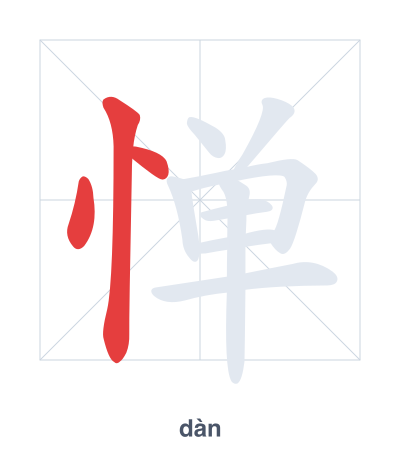
Open Hanzi Writer to see the animated stroke order and practice writing 惮 with real-time feedback.
The character 惮 (dàn) is written with 11 strokes. Follow the standard Chinese stroke order: top to bottom, left to right, outside before inside. The radical 忄 is one of its key components.
Practice the correct stroke order with the Hanzi Writer app to see animated stroke-by-stroke guidance with real-time feedback.
惮 means to fear.
The character 惮 is a phono-semantic compound. The left radical 忄 (heart) indicates emotion, while the right part 单 (dān) contributes pronunciation. Historically, 单 originally depicted a hunting weapon or a single person, and combined with the heart radical, it evokes the idea of a heart trembling alone in fear.
💡 Memory Tip: Picture a single (单) heart (忄) trembling with fear, as if alone in a dark room.
没什么好忌惮的。
méi shén me hǎo jì dàn de
There is nothing to fear.
他做事肆无忌惮。
tā zuò shì sì wú jì dàn
He acts unscrupulously and without restraint.
我们不惮辛苦。
wǒ men bù dàn xīn kǔ
We do not fear hard work.
Open Hanzi Writer to see the animated stroke order and practice writing 惮 with real-time feedback.
✨ Animated stroke order · Handwriting recognition · HSK-graded practice · Free to use
The character 惮 combines the radical 忄 (heart/mind) on the left with 单 (dān, single) on the right. The radical 忄 indicates the meaning relates to emotions or feelings, while 单 provides a phonetic hint. Together, they represent the emotion of fear that makes the heart feel "alone" or vulnerable.