肆 (sì) means "four (formal); unrestrained; shop" in Chinese. It has 13 strokes with the radical 聿, and is HSK Level 7.
Rated 4.2/5 in difficulty (advanced).
Harder than 83% of HSK Level 7 characters.
Appears in 3+ common words including 放肆 (fàng sì), 肆意 (sì yì), 酒肆 (jiǔ sì).
Due to its 13 strokes, Hanzi Writer's error detection shows 肆 requires focused practice — most learners need 10+ attempts for consistent accuracy.
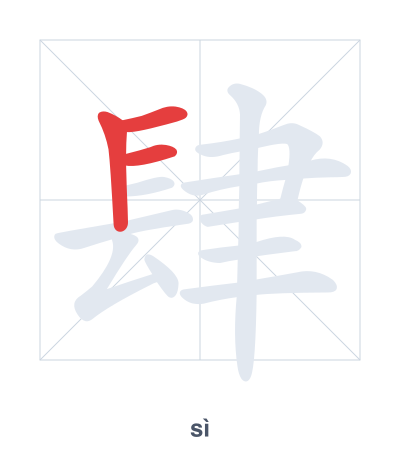
Open Hanzi Writer to see the animated stroke order and practice writing 肆 with real-time feedback.
The character 肆 (sì) is written with 13 strokes. Follow the standard Chinese stroke order: top to bottom, left to right, outside before inside. The radical 聿 is one of its key components.
Practice the correct stroke order with the Hanzi Writer app to see animated stroke-by-stroke guidance with real-time feedback.
肆 means four (formal); unrestrained; shop.
As an HSK Level 7 character, 肆 is an intermediate-level character.
肆 combines 镸 (long, extended) and 聿 (writing brush), originally depicting the act of extending a brush to set forth or display something. This evolved to mean 'unrestrained' (acting without limits) and was later borrowed as the formal numeral for 'four' to prevent forgery in financial documents.
💡 Memory Tip: Picture a frantic shopkeeper (肆) with a long, unruly ponytail (镸) wildly painting the number 'four' with a huge brush (聿) because he's too unrestrained to write it properly.
你说话太放肆了。
nǐ shuō huà tài fàng sì le
You are speaking too insolently.
不能肆意破坏公物。
bù néng sì yì pò huài gōng wù
Public property must not be wantonly damaged.
古代路边有很多酒肆。
gǔ dài lù biān yǒu hěn duō jiǔ sì
In ancient times, there were many wine shops along the roadside.
Open Hanzi Writer to see the animated stroke order and practice writing 肆 with real-time feedback.
✨ Animated stroke order · Handwriting recognition · HSK-graded practice · Free to use
The character 肆 is composed of two parts: the left component 镸 (meaning 'long') and the right radical 聿 (meaning 'brush'). The brush radical hints at writing or legal documents, while 'long' suggests extending or stretching, which connects to the meaning 'unrestrained'. The meanings 'four (formal)' and 'shop' are phonetic loans, not directly related to the components.