啖 (dàn) means "To eat; to chew; to bite" in Chinese. It has 11 strokes with the radical 口.
Rated 4.2/5 in difficulty (advanced).
Appears in 3+ common words including 啖食 (dàn shí), 啖饭 (dàn fàn), 啖肉 (dàn ròu).
Due to its 11 strokes, Hanzi Writer's error detection shows 啖 requires focused practice — most learners need 10+ attempts for consistent accuracy.
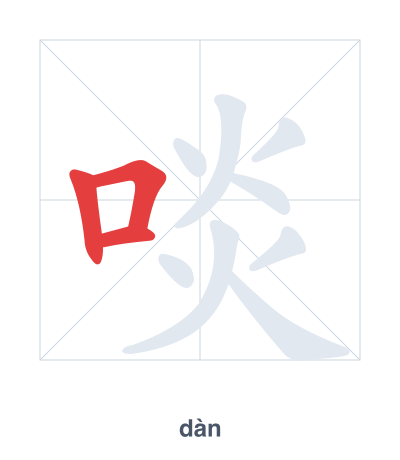
Open Hanzi Writer to see the animated stroke order and practice writing 啖 with real-time feedback.
The character 啖 (dàn) is written with 11 strokes. Follow the standard Chinese stroke order: top to bottom, left to right, outside before inside. The radical 口 is one of its key components.
Practice the correct stroke order with the Hanzi Writer app to see animated stroke-by-stroke guidance with real-time feedback.
啖 means To eat; to chew; to bite.
This character is a phono-semantic compound combining the mouth radical 口 (kǒu) with the phonetic component 炎 (yán, meaning 'flames'). The mouth indicates the action of eating or biting, while the flames may evoke eating hot or intense food, suggesting vigorous chewing or devouring.
💡 Memory Tip: Imagine a mouth (口) biting into two flames (炎) — that's eating something so spicy it burns!
这种动物啖食小虫。
zhè zhǒng dòng wù dàn shí xiǎo chóng
This animal eats small insects.
他正在大口啖饭。
tā zhèng zài dà kǒu dàn fàn
He is eating a meal in large mouthfuls.
诗人喜欢大口啖肉。
shī rén xǐ huān dà kǒu dàn ròu
The poet likes to eat meat in large mouthfuls.
Open Hanzi Writer to see the animated stroke order and practice writing 啖 with real-time feedback.
✨ Animated stroke order · Handwriting recognition · HSK-graded practice · Free to use
啖 is made of two parts: the radical 口 (mouth) on the left and 炎 (flame) on the right. The mouth radical shows the meaning is about mouth actions, while 炎 hints at eating hot or cooked food, as fire is used in cooking.