擢 (zhuó) means "to promote; to select" in Chinese. It has 17 strokes with the radical 扌.
Rated 4.2/5 in difficulty (advanced).
Appears in 3+ common words including 擢升 (zhuó shēng), 擢拔 (zhuó bá), 擢用 (zhuó yòng).
Due to its 17 strokes, Hanzi Writer's error detection shows 擢 requires focused practice — most learners need 10+ attempts for consistent accuracy.
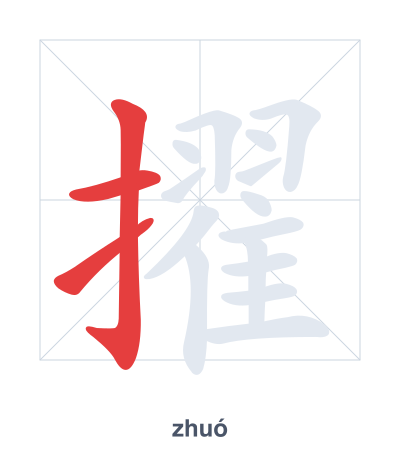
Open Hanzi Writer to see the animated stroke order and practice writing 擢 with real-time feedback.
The character 擢 (zhuó) is written with 17 strokes. Follow the standard Chinese stroke order: top to bottom, left to right, outside before inside. The radical 扌 is one of its key components.
Practice the correct stroke order with the Hanzi Writer app to see animated stroke-by-stroke guidance with real-time feedback.
擢 means to promote; to select.
The character combines the hand radical (扌) on the left with 翟 (dí), which depicts a long-tailed bird. Originally meaning 'to pluck out'—as in pulling a feather from a bird—it extended metaphorically to mean 'to select and elevate someone from a group,' like plucking them upward for promotion.
💡 Memory Tip: Imagine a hand (扌) plucking a bird's feather (翟) as a reward—the bird is suddenly 'promoted' to a higher perch.
他被擢升为经理。
tā bèi zhuó shēng wèi jīng lǐ
He was promoted to manager.
校长擢拔了新老师。
xiào zhǎng zhuó bá le xīn lǎo shī
The principal promoted the new teacher.
公司擢用了不少人才。
gōng sī zhuó yòng le bù shǎo rén cái
The company promoted many talented people.
Open Hanzi Writer to see the animated stroke order and practice writing 擢 with real-time feedback.
✨ Animated stroke order · Handwriting recognition · HSK-graded practice · Free to use
The character 擢 has the hand radical 扌 on the left, indicating an action done with the hand. The right side is 翟 (dí, a type of long-tailed bird), which gives the sound and also suggests the idea of lifting or raising, like pulling someone upward. Together, the character conveys the hand lifting someone up, meaning to promote or select.