擡 (tái) means "to lift; to raise; to carry" in Chinese. It has 17 strokes with the radical 扌.
Rated 4.2/5 in difficulty (advanced).
Appears in 3+ common words including 擡头 (tái tóu), 擡手 (tái shǒu), 擡桌子 (tái zhuō zi).
Due to its 17 strokes, Hanzi Writer's error detection shows 擡 requires focused practice — most learners need 10+ attempts for consistent accuracy.
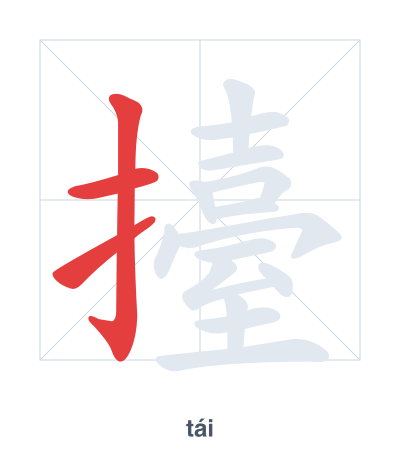
Open Hanzi Writer to see the animated stroke order and practice writing 擡 with real-time feedback.
The character 擡 (tái) is written with 17 strokes. Follow the standard Chinese stroke order: top to bottom, left to right, outside before inside. The radical 扌 is one of its key components.
Practice the correct stroke order with the Hanzi Writer app to see animated stroke-by-stroke guidance with real-time feedback.
擡 means to lift; to raise; to carry.
The character 擡 combines the hand radical 扌 (action) with 臺 (tái, a platform or tower), suggesting raising something up onto a platform. It is a variant of the simpler 抬, sharing the same meaning of lifting or carrying upward.
💡 Memory Tip: Picture a hand (扌) struggling to lift a heavy platform (臺) high above the ground.
请大家擡头看黑板。
qǐng dà jiā tái tóu kàn hēi bǎn
Everyone, please look up at the blackboard.
他擡手打了个招呼。
tā tái shǒu dǎ le gè zhāo hū
He raised his hand to say hello.
我们一起擡桌子吧。
wǒ men yì qǐ tái zhuō zi ba
Let's carry the table together.
Open Hanzi Writer to see the animated stroke order and practice writing 擡 with real-time feedback.
✨ Animated stroke order · Handwriting recognition · HSK-graded practice · Free to use
擡 is a phono-semantic compound. The left side 扌 means "hand," and the right side 臺 (tái, meaning "platform") gives the sound and also suggests lifting something onto a platform. Together, the character means to lift, raise, or carry with the hand.