擤 (xǐng) means "To blow (one's nose)" in Chinese. It has 17 strokes with the radical 扌.
Rated 4.2/5 in difficulty (advanced).
Appears in 3+ common words including 擤鼻涕 (xǐng bí tì), 擤鼻子 (xǐng bí zi), 擤一下 (xǐng yī xià).
Due to its 17 strokes, Hanzi Writer's error detection shows 擤 requires focused practice — most learners need 10+ attempts for consistent accuracy.
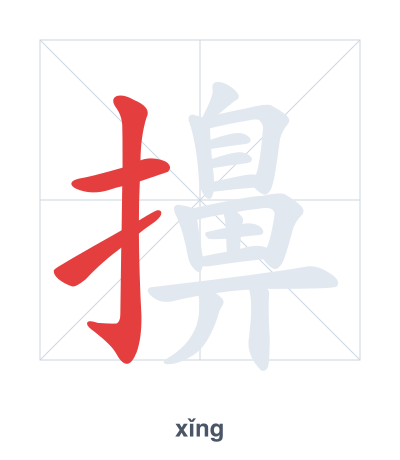
Open Hanzi Writer to see the animated stroke order and practice writing 擤 with real-time feedback.
The character 擤 (xǐng) is written with 17 strokes. Follow the standard Chinese stroke order: top to bottom, left to right, outside before inside. The radical 扌 is one of its key components.
Practice the correct stroke order with the Hanzi Writer app to see animated stroke-by-stroke guidance with real-time feedback.
擤 means To blow (one's nose).
This character is a compound of the hand radical 扌, indicating an action, and 鼻 (nose), the body part involved. Together, they depict the act of using a hand to blow one's nose. The right side 鼻 itself combines 自 (original image of a nose) and 畀 (to give), but here it simply represents the nose.
💡 Memory Tip: Picture a hand (扌) pinching a giant nose (鼻) and giving a loud, snotty blow.
感冒了要擤鼻涕。
gǎn mào le yào xǐng bí tì
Blow your nose when you have a cold.
他拿纸巾擤鼻子。
tā ná zhǐ jīn xǐng bí zi
He used a tissue to blow his nose.
用力擤一下鼻子。
yòng lì xǐng yī xià bí zi
Blow your nose hard.
Open Hanzi Writer to see the animated stroke order and practice writing 擤 with real-time feedback.
✨ Animated stroke order · Handwriting recognition · HSK-graded practice · Free to use
The character 擤 combines the radical 扌 (hand) on the left with the phonetic component 鼻 (nose) on the right. The hand radical indicates the action is done with the hand, and 鼻 gives the meaning of nose, so together they mean "to blow one's nose" using your hand.