凑 (còu) means "to gather together; to pool; to happen by chance" in Chinese. It has 11 strokes with the radical 冫, and is HSK Level 7.
Rated 3.9/5 in difficulty (challenging).
Harder than 34% of HSK Level 7 characters.
Appears in 3+ common words including 凑巧 (còu qiǎo), 凑钱 (còu qián), 凑数 (còu shù).
Due to its 11 strokes, Hanzi Writer's error detection shows 凑 requires focused practice — most learners need 10+ attempts for consistent accuracy.
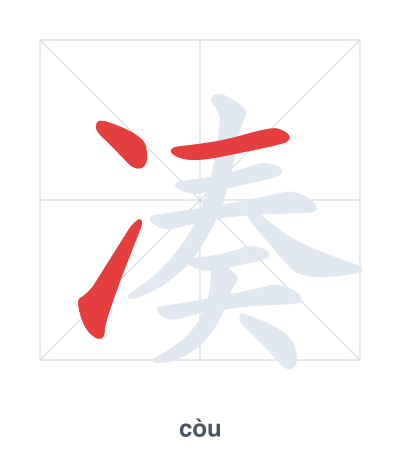
Open Hanzi Writer to see the animated stroke order and practice writing 凑 with real-time feedback.
The character 凑 (còu) is written with 11 strokes. Follow the standard Chinese stroke order: top to bottom, left to right, outside before inside. The radical 冫 is one of its key components.
Practice the correct stroke order with the Hanzi Writer app to see animated stroke-by-stroke guidance with real-time feedback.
凑 means to gather together; to pool; to happen by chance.
As an HSK Level 7 character, 凑 is an intermediate-level character.
凑 is a phono-semantic compound where 奏 (zòu, 'to play music') provides both the sound and a hint of 'gathering' (as musicians gather to play), while the radical 冫 (ice) originally came from 氵 (water) in the older variant 湊, symbolizing streams converging into one. Thus the character visually suggests people or things coming together like flowing water or ice crystals forming a cluster.
💡 Memory Tip: Imagine two ice cubes (冫) sliding together to join a musical performance (奏), as the band members gather to play—'còu' means to assemble or happen by chance.
这件事真是太凑巧了。
zhè jiàn shì zhēn shì tài còu qiǎo le
This is such a coincidence.
大家凑钱买了一份礼物。
dà jiā còu qián mǎi le yī fèn lǐ wù
Everyone chipped in to buy a gift.
我只是来这里凑数的。
wǒ zhǐ shì lái zhè lǐ còu shù de
I'm just here to make up the numbers.
Open Hanzi Writer to see the animated stroke order and practice writing 凑 with real-time feedback.
✨ Animated stroke order · Handwriting recognition · HSK-graded practice · Free to use
凑 has the radical 冫 (ice) on the left and 奏 (to play music) on the right. The right side gives the sound, while the meaning "to gather" comes from the idea of things or people coming together, like water droplets gathering. However, the ice radical does not directly connect to the meaning; this is a phonetic compound.