准 (zhǔn) means "accurate; standard; to allow" in Chinese. It has 10 strokes with the radical 冫, and is HSK Level 1.
Rated 3.4/5 in difficulty (challenging).
Harder than 72% of HSK Level 1 characters.
Appears in 3+ common words including 准备 (zhǔn bèi), 准确 (zhǔn què), 标准 (biāo zhǔn).
Due to its 10 strokes, Hanzi Writer's error detection shows 准 requires focused practice — most learners need 10+ attempts for consistent accuracy.
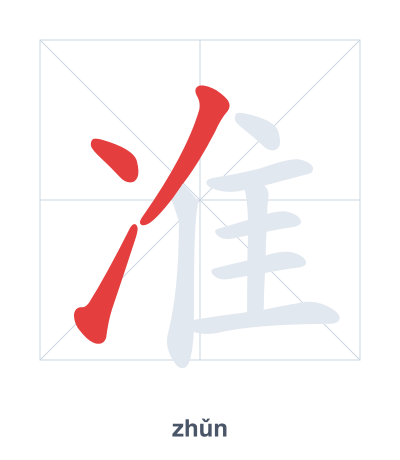
Open Hanzi Writer to see the animated stroke order and practice writing 准 with real-time feedback.
The character 准 (zhǔn) is written with 10 strokes. Follow the standard Chinese stroke order: top to bottom, left to right, outside before inside. The radical 冫 is one of its key components.
Practice the correct stroke order with the Hanzi Writer app to see animated stroke-by-stroke guidance with real-time feedback.
准 means accurate; standard; to allow.
As an HSK Level 1 character, 准 is among the first characters beginners learn.
The character 准 is a simplified form of 準, which originally depicted a falcon (隼) with water (水) emphasizing a level surface—like a water level used for measuring. The left component 冫 (ice) replaces water, retaining the idea of a cold, precise standard. Together, the bird and ice suggest a fixed, accurate measure or permission to act within set bounds.
💡 Memory Tip: Picture a bird (隹) balancing perfectly on a block of ice (冫), demonstrating extreme accuracy to avoid slipping.
我正在准备考试。
wǒ zhèng zài zhǔn bèi kǎo shì
I am preparing for an exam.
他的回答很准确。
tā de huí dá hěn zhǔn què
His answer is very accurate.
你的发音很标准。
nǐ de fā yīn hěn biāo zhǔn
Your pronunciation is very standard.
Open Hanzi Writer to see the animated stroke order and practice writing 准 with real-time feedback.
✨ Animated stroke order · Handwriting recognition · HSK-graded practice · Free to use
准 has two parts: the left radical 冫 (ice) and the right part 隹 (a short-tailed bird). Originally, the character 準 (simplified to 准) meant to level water, with 冫 hinting at water or cold and 隹 giving a phonetic clue. Over time, it came to mean 'accurate', 'standard', and 'to allow'.