凄 (qī) means "desolate; chilly" in Chinese. It has 10 strokes with the radical 冫, and is HSK Level 7.
Rated 3.9/5 in difficulty (challenging).
Harder than 34% of HSK Level 7 characters.
Appears in 3+ common words including 凄凉 (qī liáng), 凄惨 (qī cǎn), 凄美 (qī měi).
Due to its 10 strokes, Hanzi Writer's error detection shows 凄 requires focused practice — most learners need 10+ attempts for consistent accuracy.
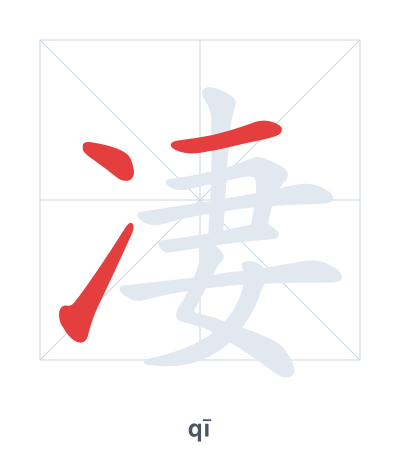
Open Hanzi Writer to see the animated stroke order and practice writing 凄 with real-time feedback.
The character 凄 (qī) is written with 10 strokes. Follow the standard Chinese stroke order: top to bottom, left to right, outside before inside. The radical 冫 is one of its key components.
Practice the correct stroke order with the Hanzi Writer app to see animated stroke-by-stroke guidance with real-time feedback.
凄 means desolate; chilly.
As an HSK Level 7 character, 凄 is an intermediate-level character.
凄 (qī) is a phono-semantic compound: the left radical 冫 (ice) indicates its connection to cold and freezing, while the right component 妻 (qī, 'wife') provides the pronunciation. Originally meaning 'chilly' or 'cold,' the character later extended to describe a desolate, bleak emotional state.
💡 Memory Tip: Picture a wife (妻) abandoned on a block of ice (冫), shivering in a desolate, chilly landscape.
这里的景色很凄凉。
zhè lǐ de jǐng sè hěn qī liáng
The scenery here is very desolate.
他的身世非常凄惨。
tā de shēn shì fēi cháng qī cǎn
His life story is very tragic.
这是一个凄美的故事。
zhè shì yí gè qī měi de gù shì
This is a poignantly beautiful story.
Open Hanzi Writer to see the animated stroke order and practice writing 凄 with real-time feedback.
✨ Animated stroke order · Handwriting recognition · HSK-graded practice · Free to use
The character 凄 is made of the radical 冫 (ice, cold) on the left and 妻 (wife) on the right. The radical 冫 gives the idea of cold or chill, while 妻 provides the sound and suggests a sense of loneliness or desolation. Together, they create the meaning of a chilly, desolate feeling.