啜 (chuài/chuò) means "To sip; to sob" in Chinese. It has 11 strokes with the radical 口.
Rated 4.2/5 in difficulty (advanced).
Appears in 3+ common words including 啜泣 (chuò qì), 啜饮 (chuài yǐn), 啜一口 (chuài yī kǒu).
Due to its 11 strokes, Hanzi Writer's error detection shows 啜 requires focused practice — most learners need 10+ attempts for consistent accuracy.
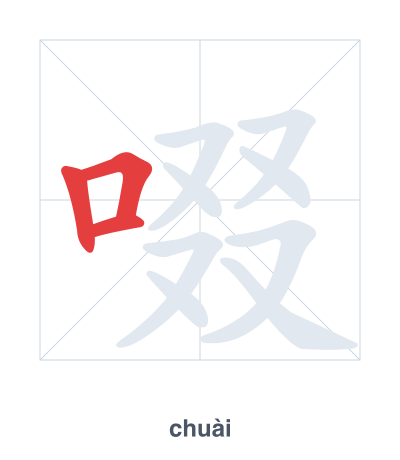
Open Hanzi Writer to see the animated stroke order and practice writing 啜 with real-time feedback.
The character 啜 (chuài/chuò) is written with 11 strokes. Follow the standard Chinese stroke order: top to bottom, left to right, outside before inside. The radical 口 is one of its key components.
Practice the correct stroke order with the Hanzi Writer app to see animated stroke-by-stroke guidance with real-time feedback.
啜 means To sip; to sob.
This is a polyphonic character with readings: chuài, chuò.
The character 啜 combines the mouth radical 口 with the phonetic component 叕 (zhuó), which means 'to connect' or 'a series of small stitches.' Together, they suggest repeated mouth movements—either sipping a liquid in small, connected sips or producing short, sobbing sounds.
💡 Memory Tip: Picture a mouth (口) taking tiny, repeated sips from four separate cups (the four '又' inside 叕), each time making a little 'chuai' sob.
她在角落里小声啜泣。
tā zài jiǎo luò lǐ xiǎo shēng chuò qì
She is sobbing quietly in the corner.
他在慢慢啜饮热茶。
tā zài màn màn chuài yǐn rè chá
He is slowly sipping hot tea.
他啜了一口咖啡。
tā chuài le yī kǒu kā fēi
He took a sip of coffee.
Open Hanzi Writer to see the animated stroke order and practice writing 啜 with real-time feedback.
✨ Animated stroke order · Handwriting recognition · HSK-graded practice · Free to use
啜 is a left-right character. The left side is 口 (mouth radical), which links to the actions of sipping or sobbing that involve the mouth. The right side is 叕 (chuò), which provides the sound and also suggests repeating or connecting, like taking small repeated sips or sobs.