褫 (chǐ) means "to strip; to deprive of" in Chinese. It has 15 strokes with the radical 衤.
Rated 4.2/5 in difficulty (advanced).
Appears in 3+ common words including 褫夺 (chǐ duó), 褫职 (chǐ zhí), 褫革 (chǐ gé).
Due to its 15 strokes, Hanzi Writer's error detection shows 褫 requires focused practice — most learners need 10+ attempts for consistent accuracy.
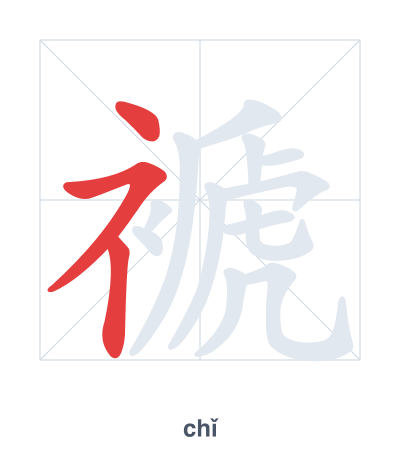
Open Hanzi Writer to see the animated stroke order and practice writing 褫 with real-time feedback.
The character 褫 (chǐ) is written with 15 strokes. Follow the standard Chinese stroke order: top to bottom, left to right, outside before inside. The radical 衤 is one of its key components.
Practice the correct stroke order with the Hanzi Writer app to see animated stroke-by-stroke guidance with real-time feedback.
褫 means to strip; to deprive of.
褫 is a phono-semantic compound. The left radical 衤 (衣) represents clothing, indicating the meaning relates to garments. The right component 虒 (sì) provides the sound, while the character's meaning 'to strip' or 'deprive' derives from the act of forcibly removing clothing.
💡 Memory Tip: Picture a tiger (虒) grabbing your coat (衤) and ripping it off, stripping you of your clothes.
他的权力被褫夺了。
tā de quán lì bèi chǐ duó le
His power was stripped away.
他因为犯错被褫职。
tā yīn wèi fàn cuò bèi chǐ zhí
He was dismissed from his post for making a mistake.
他被褫革了名号。
tā bèi chǐ gé le míng hào
He was stripped of his titles.
Open Hanzi Writer to see the animated stroke order and practice writing 褫 with real-time feedback.
✨ Animated stroke order · Handwriting recognition · HSK-graded practice · Free to use
The left side is the radical 衤 (clothing), and the right side is 虒 (sī, a mythical tiger-like beast). Together, they suggest the action of stripping off clothes, which extended to mean 'to strip' or 'to deprive' of rights or rank.