瘥 (chài) means "to recover from illness" in Chinese. It has 14 strokes with the radical 疒.
Rated 4.2/5 in difficulty (advanced).
Appears in 3+ common words including 病瘥 (bìng chài), 瘥后 (chài hòu), 瘥减 (chài jiǎn).
Due to its 14 strokes, Hanzi Writer's error detection shows 瘥 requires focused practice — most learners need 10+ attempts for consistent accuracy.
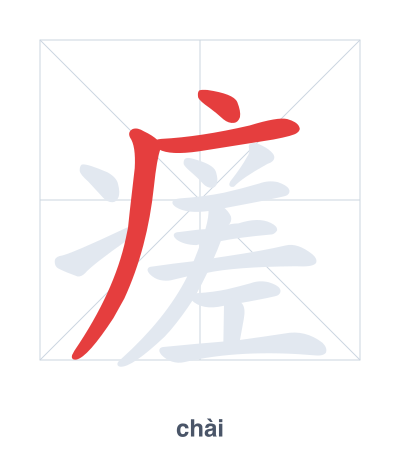
Open Hanzi Writer to see the animated stroke order and practice writing 瘥 with real-time feedback.
The character 瘥 (chài) is written with 14 strokes. Follow the standard Chinese stroke order: top to bottom, left to right, outside before inside. The radical 疒 is one of its key components.
Practice the correct stroke order with the Hanzi Writer app to see animated stroke-by-stroke guidance with real-time feedback.
瘥 means to recover from illness.
瘥 combines the illness radical 疒 (a person lying on a bed) with 差 (chà, 'difference'), which provides the sound and suggests that the illness has become 'different'—i.e., it has changed for the better. This semantic-phonetic compound originally meant 'to recover from sickness,' with the sick person now well again.
💡 Memory Tip: Picture a sick person on a bed (疒) who suddenly springs up to do a lively cha-cha dance (sounds like 差 'chai') because they've fully recovered.
他的病已经瘥了。
tā de bìng yǐ jīng chài le
He has recovered from his illness.
瘥后要注意休息。
chài hòu yào zhù yì xiū xī
One should rest after recovering from an illness.
他的病情有所瘥减。
tā de bìng qíng yǒu suǒ chài jiǎn
His condition has improved slightly.
Open Hanzi Writer to see the animated stroke order and practice writing 瘥 with real-time feedback.
✨ Animated stroke order · Handwriting recognition · HSK-graded practice · Free to use
The character 瘥 has the radical 疒 (illness) on the left, which indicates it relates to sickness or disease. The right part is 差 (chà, meaning 'difference' or 'to lack'), but here it adds the idea of recovery. Together, 瘥 means the illness is 'leaving' or 'recovering.'