簿 (bù) means "notebook / ledger / register" in Chinese. It has 19 strokes with the radical 竹.
Rated 4.2/5 in difficulty (advanced).
Appears in 3+ common words including 练习簿 (liàn xí bù), 账簿 (zhàng bù), 名簿 (míng bù).
Due to its 19 strokes, Hanzi Writer's error detection shows 簿 requires focused practice — most learners need 10+ attempts for consistent accuracy.
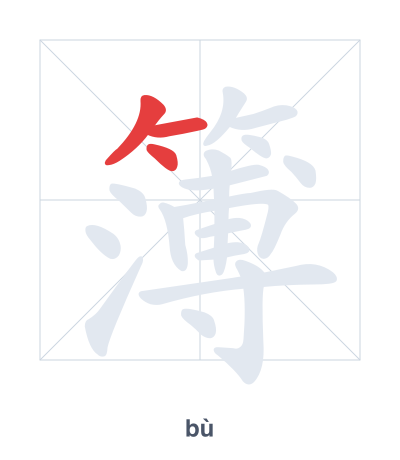
Open Hanzi Writer to see the animated stroke order and practice writing 簿 with real-time feedback.
The character 簿 (bù) is written with 19 strokes. Follow the standard Chinese stroke order: top to bottom, left to right, outside before inside. The radical 竹 is one of its key components.
Practice the correct stroke order with the Hanzi Writer app to see animated stroke-by-stroke guidance with real-time feedback.
簿 means notebook / ledger / register.
簿 combines the bamboo radical ⺮, reflecting that ancient notebooks were made of bamboo strips, with 溥 as a phonetic component. The structure thus links the material of writing to the concept of a ledger or register.
💡 Memory Tip: Picture a bamboo (⺮) notebook soaked in water (氵) where you must spread (尃) the pages to dry them off.
请把作业写在练习簿上。
qǐng bǎ zuò yè xiě zài liàn xí bù shàng
Please write the homework in the exercise book.
会计正在仔细检查账簿。
kuài jì zhèng zài zǐ xì jiǎn chá zhàng bù
The accountant is carefully checking the account books.
老师在名簿上记录学生名字。
lǎo shī zài míng bù shàng jì lù xué shēng míng zì
The teacher is recording students' names in the register.
Open Hanzi Writer to see the animated stroke order and practice writing 簿 with real-time feedback.
✨ Animated stroke order · Handwriting recognition · HSK-graded practice · Free to use
簿 is composed of the radical 竹 (bamboo) on top and the phonetic component 薄 (bó, meaning 'thin') below. Bamboo relates to ancient writing materials (bamboo slips), and 薄 provides the sound, while the overall meaning of 'notebook or ledger' comes from recording on bamboo or paper.