篼 (dōu) means "basket or sedan chair" in Chinese. It has 17 strokes with the radical 竹.
Rated 4.2/5 in difficulty (advanced).
Appears in 3+ common words including 背篼 (bèi dōu), 篼子 (dōu zi), 竹篼 (zhú dōu).
Due to its 17 strokes, Hanzi Writer's error detection shows 篼 requires focused practice — most learners need 10+ attempts for consistent accuracy.
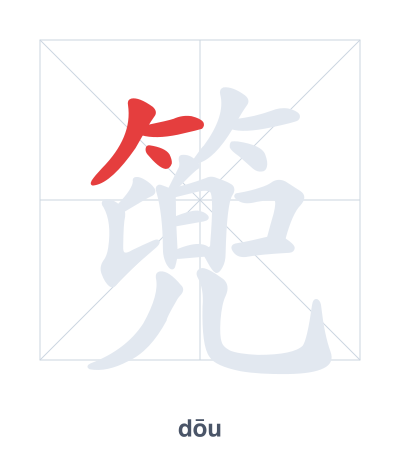
Open Hanzi Writer to see the animated stroke order and practice writing 篼 with real-time feedback.
The character 篼 (dōu) is written with 17 strokes. Follow the standard Chinese stroke order: top to bottom, left to right, outside before inside. The radical 竹 is one of its key components.
Practice the correct stroke order with the Hanzi Writer app to see animated stroke-by-stroke guidance with real-time feedback.
篼 means basket or sedan chair.
It is a compound character formed from the radical 竹 (bamboo, indicating the material) and the phonetic component 兜 (dōu, originally 'helmet' or 'bag'). Together they depict a container woven from bamboo, such as a basket or a sedan chair made of bamboo slats.
💡 Memory Tip: Imagine a bamboo (竹) helmet (兜) turned into a basket that you carry like a sedan chair.
那个背篼很大。
nà ge bèi dōu hěn dà
That back basket is very large.
把菜放进篼子里。
bǎ cài fàng jìn dōu zi lǐ
Put the vegetables into the basket.
这是一个竹篼。
zhè shì yí gè zhú dōu
This is a bamboo basket.
Open Hanzi Writer to see the animated stroke order and practice writing 篼 with real-time feedback.
✨ Animated stroke order · Handwriting recognition · HSK-graded practice · Free to use
篼 is made of two parts: the top radical 竹 (bamboo) and the bottom part 兜 (dōu). The radical shows that the item is made of bamboo, while 兜 suggests a container shape because it originally means a pocket or bag. Together they form the idea of a bamboo basket or sedan chair.