篾 (miè) means "bamboo strip" in Chinese. It has 17 strokes with the radical 竹.
Rated 4.2/5 in difficulty (advanced).
Appears in 3+ common words including 竹篾 (zhú miè), 篾筐 (miè kuāng), 篾席 (miè xí).
Due to its 17 strokes, Hanzi Writer's error detection shows 篾 requires focused practice — most learners need 10+ attempts for consistent accuracy.
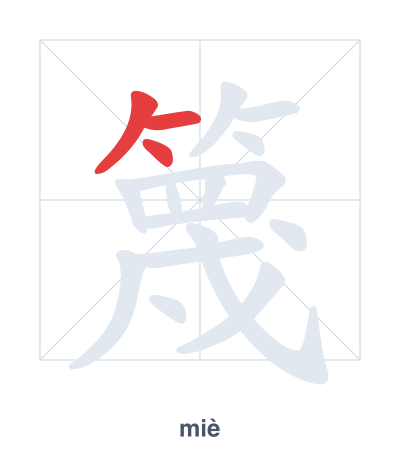
Open Hanzi Writer to see the animated stroke order and practice writing 篾 with real-time feedback.
The character 篾 (miè) is written with 17 strokes. Follow the standard Chinese stroke order: top to bottom, left to right, outside before inside. The radical 竹 is one of its key components.
Practice the correct stroke order with the Hanzi Writer app to see animated stroke-by-stroke guidance with real-time feedback.
篾 means bamboo strip.
篾 is a phono-semantic compound where the top radical 竹 (bamboo) indicates the material, and the bottom component 蔑 (miè) provides pronunciation, while also hinting at thinness or slightness. The character visually shows bamboo (竹) above, with the lower part 蔑 originally depicting a person wearing a net-like headdress, now abstracted to represent the thin, split bamboo strips used for weaving.
💡 Memory Tip: Picture bamboo stalks (竹) being shaved into thin, flexible strips that form a crisscross net (蔑, like a woven eye pattern).
他用竹篾编了一个篮子。
tā yòng zhú miè biān le yí gè lán zi
He wove a basket with bamboo strips.
篾筐里装着新鲜的水果。
miè kuāng lǐ zhuāng zhe xīn xiān de shuǐ guǒ
The bamboo basket is filled with fresh fruit.
夏天睡篾席很凉快。
xià tiān shuì miè xí hěn liáng kuài
Sleeping on a bamboo strip mat in summer is very cool.
Open Hanzi Writer to see the animated stroke order and practice writing 篾 with real-time feedback.
✨ Animated stroke order · Handwriting recognition · HSK-graded practice · Free to use
The character 篾 is composed of the radical 竹 (bamboo) on top, which indicates the material, and the phonetic component 蔑 (miè) below. This structure shows that the meaning "bamboo strip" comes from the bamboo radical, while 蔑 provides the pronunciation. While 蔑 itself means "to despise," in this character it only contributes sound, not meaning.