框 (kuàng) means "frame; case" in Chinese. It has 10 strokes with the radical 木, and is HSK Level 7.
Rated 4.2/5 in difficulty (advanced).
Harder than 63% of HSK Level 7 characters.
Appears in 2+ common words including 门框 (mén kuàng), 镜框 (jìng kuàng).
Due to its 10 strokes, Hanzi Writer's error detection shows 框 requires focused practice — most learners need 10+ attempts for consistent accuracy.
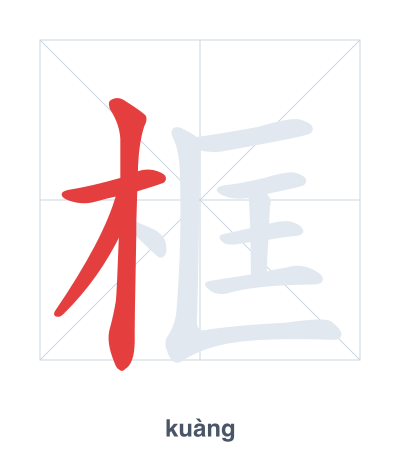
Open Hanzi Writer to see the animated stroke order and practice writing 框 with real-time feedback.
The character 框 (kuàng) is written with 10 strokes. Follow the standard Chinese stroke order: top to bottom, left to right, outside before inside. The radical 木 is one of its key components.
Practice the correct stroke order with the Hanzi Writer app to see animated stroke-by-stroke guidance with real-time feedback.
框 means frame; case.
As an HSK Level 7 character, 框 is an intermediate-level character.
This character is a phono-semantic compound combining the radical 木 (wood, indicating material) with 匡 (kuāng, which originally depicted a square container and also provides the sound). Together they represent a wooden frame or case, like a picture frame or a window frame.
💡 Memory Tip: Picture a wooden square (木) with a big 'boxy' mouth (匡) that holds a picture like a frame.
他撞到了门框上。
tā zhuàng dào le mén kuàng shàng
He bumped into the door frame.
这个镜框是金色的。
zhè ge jìng kuàng shì jīn sè de
This frame is gold.
Open Hanzi Writer to see the animated stroke order and practice writing 框 with real-time feedback.
✨ Animated stroke order · Handwriting recognition · HSK-graded practice · Free to use
框 is a left-right character. The left side is 木 (wood), indicating that frames were traditionally made of wood. The right side is 匡 (kuāng), which gives the sound and also suggests the idea of a rectangular enclosure or frame.