摽 (biāo) means "to bind or compete" in Chinese. It has 14 strokes with the radical 扌.
Rated 4.2/5 in difficulty (advanced).
Appears in 3+ common words including 摽劲儿 (biāo jìn er), 摽在一起 (biāo zài yì qǐ), 摽着 (biāo zhe).
Due to its 14 strokes, Hanzi Writer's error detection shows 摽 requires focused practice — most learners need 10+ attempts for consistent accuracy.
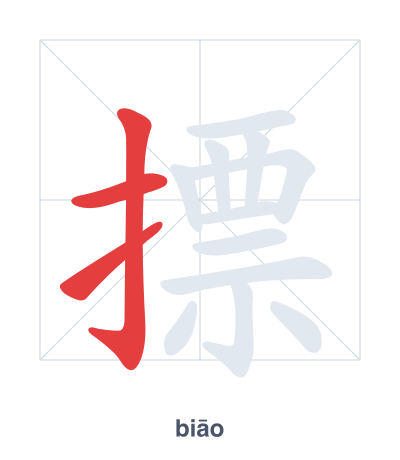
Open Hanzi Writer to see the animated stroke order and practice writing 摽 with real-time feedback.
The character 摽 (biāo) is written with 14 strokes. Follow the standard Chinese stroke order: top to bottom, left to right, outside before inside. The radical 扌 is one of its key components.
Practice the correct stroke order with the Hanzi Writer app to see animated stroke-by-stroke guidance with real-time feedback.
摽 means to bind or compete.
摽 combines the hand radical 扌 with 票 as a phonetic component. Its original meaning was to strike, later extending to binding and competing—like binding a target marker for a contest.
💡 Memory Tip: Picture a hand (扌) securely binding a ticket (票) to a post, marking the spot for a fierce competition.
别跟他摽劲儿。
bié gēn tā biāo jìn er
Don't compete with him out of spite.
两个车摽在一起。
liǎng gè chē biāo zài yì qǐ
The two cars are locked together.
他们俩总是摽着。
tā men liǎ zǒng shì biāo zhe
The two of them are always together.
Open Hanzi Writer to see the animated stroke order and practice writing 摽 with real-time feedback.
✨ Animated stroke order · Handwriting recognition · HSK-graded practice · Free to use
The character 摽 is made of the hand radical 扌 on the left and the phonetic component 票 on the right. The hand radical shows the action is done with the hands, like binding or competing. 票 mostly gives the sound, but its original meaning of 'floating' may hint at the idea of forces pushing against each other in a competition.