篦 (bì) means "fine-toothed comb" in Chinese. It has 16 strokes with the radical 竹.
Rated 4.2/5 in difficulty (advanced).
Appears in 3+ common words including 篦子 (bì zi), 篦头 (bì tóu), 竹篦 (zhú bì).
Due to its 16 strokes, Hanzi Writer's error detection shows 篦 requires focused practice — most learners need 10+ attempts for consistent accuracy.
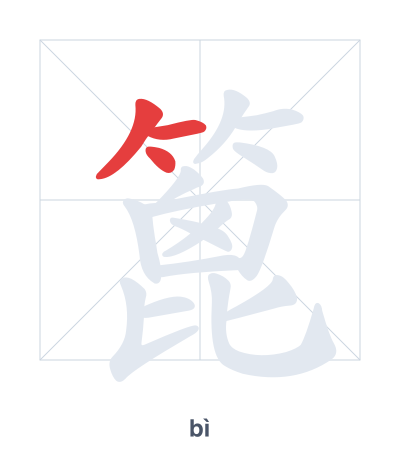
Open Hanzi Writer to see the animated stroke order and practice writing 篦 with real-time feedback.
The character 篦 (bì) is written with 16 strokes. Follow the standard Chinese stroke order: top to bottom, left to right, outside before inside. The radical 竹 is one of its key components.
Practice the correct stroke order with the Hanzi Writer app to see animated stroke-by-stroke guidance with real-time feedback.
篦 means fine-toothed comb.
篦 is a compound character with the radical 竹 (bamboo) on top, indicating the material, and the component 甾 below, which originally served as a phonetic hint. Fine-toothed combs were traditionally made from bamboo splints. The lower part 甾 may also evoke the dense, closely spaced teeth of the comb.
💡 Memory Tip: Imagine a bamboo comb (竹) so fine that its teeth can pick apart a tangled, spiky nest (甾 looks like a messy grid) of hair.
我买了一个篦子。
wǒ mǎi le yí gè bì zi
I bought a fine-toothed comb.
以前的人常篦头。
yǐ qián de rén cháng bì tóu
People in the past often used fine-toothed combs.
这个竹篦很旧了。
zhè ge zhú bì hěn jiù le
This fine-toothed bamboo comb is very old.
Open Hanzi Writer to see the animated stroke order and practice writing 篦 with real-time feedback.
✨ Animated stroke order · Handwriting recognition · HSK-graded practice · Free to use
篦 has the radical 竹 (bamboo) on top, indicating the object is traditionally made of bamboo. The lower part 毖 (bì) gives the pronunciation and contains the components 比 and 匕, but its main role is phonetic. Together, the structure shows a bamboo fine-toothed comb.