哔 (bì) means "Beep" in Chinese. It has 9 strokes with the radical 口.
Rated 4/5 in difficulty (challenging).
Appears in 3+ common words including 哔哔 (bì bì), 哔哩哔哩 (bì lī bì lī), 哔的一声 (bì de yī shēng).
Due to its 9 strokes, Hanzi Writer's error detection shows 哔 requires focused practice — most learners need 10+ attempts for consistent accuracy.
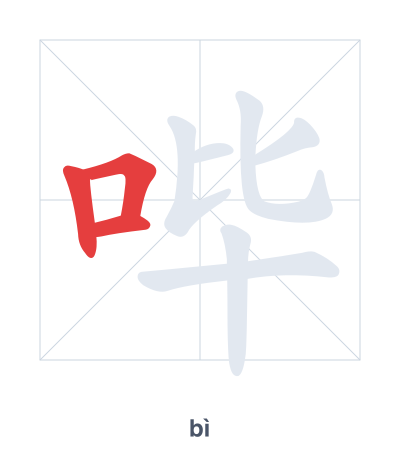
Open Hanzi Writer to see the animated stroke order and practice writing 哔 with real-time feedback.
The character 哔 (bì) is written with 9 strokes. Follow the standard Chinese stroke order: top to bottom, left to right, outside before inside. The radical 口 is one of its key components.
Practice the correct stroke order with the Hanzi Writer app to see animated stroke-by-stroke guidance with real-time feedback.
哔 means Beep.
哔 is a compound character: the radical 口 (mouth) indicates sound, and 必 (bì) provides the pronunciation. It represents the electronic 'beep' sound, like a pager or machine noise.
💡 Memory Tip: Imagine a mouth (口) opening to say 'beep' and a bee (必, sounds like 'bee') flies out making the sound.
喇叭哔哔地响。
lǎ bā bì bì dì xiǎng
The horn is beeping 'bi-bi'.
我喜欢看哔哩哔哩。
wǒ xǐ huān kàn bì lī bì lī
I like watching Bilibili.
微波炉哔的一声响了。
wēi bō lú bì de yī shēng xiǎng le
The microwave gave a beep.
Open Hanzi Writer to see the animated stroke order and practice writing 哔 with real-time feedback.
✨ Animated stroke order · Handwriting recognition · HSK-graded practice · Free to use
哔 is made of two parts: the left side 口 (mouth radical) and the right side 毕 (bì, meaning "to finish"). The mouth radical indicates that the character is related to sound, and 毕 gives the pronunciation. Together, they form an onomatopoeic character that imitates a short electronic beep.