哩 (lī) means "Particle (used in songs or for distance)" in Chinese. It has 10 strokes with the radical 口.
Rated 4.2/5 in difficulty (advanced).
Appears in 1+ common words including 哩 (lī).
Due to its 10 strokes, Hanzi Writer's error detection shows 哩 requires focused practice — most learners need 10+ attempts for consistent accuracy.
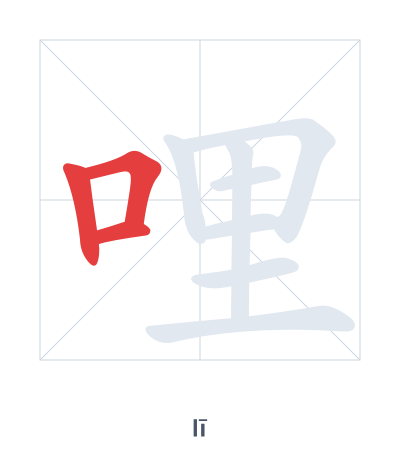
Open Hanzi Writer to see the animated stroke order and practice writing 哩 with real-time feedback.
The character 哩 (lī) is written with 10 strokes. Follow the standard Chinese stroke order: top to bottom, left to right, outside before inside. The radical 口 is one of its key components.
Practice the correct stroke order with the Hanzi Writer app to see animated stroke-by-stroke guidance with real-time feedback.
哩 means Particle (used in songs or for distance).
哩 is a phono-semantic compound: the mouth radical (口) shows it's a sound or particle, while 里 (lǐ, meaning 'mile' or 'village') provides the pronunciation and hints at its use for distance, like in 'mile' (英里).
💡 Memory Tip: Picture a mouth (口) singing 'lee, lee, lee' while a kilometer marker (里) shows you've gone a mile.
快去吧,他在那等着哩
kuài qù ba , tā zài nà děng zhe lī
Go quickly, he is waiting for you there.
他正忙着哩。
tā zhèng máng zhe lī
He is quite busy right now.
大家都在这里哩。
dà jiā dōu zài zhè lǐ lī
Everyone is right here.
Open Hanzi Writer to see the animated stroke order and practice writing 哩 with real-time feedback.
✨ Animated stroke order · Handwriting recognition · HSK-graded practice · Free to use
哩 is made of the radical 口 (mouth) on the left and the phonetic component 里 (lǐ, inside) on the right. The mouth radical indicates it is a sound-related particle, while 里 provides the pronunciation cue. Together, 哩 is used as a modal or rhythmic particle in songs rather than having a concrete meaning.