瘢 (bān) means "scar; mark; spot" in Chinese. It has 15 strokes with the radical 疒.
Rated 4.2/5 in difficulty (advanced).
Appears in 3+ common words including 瘢痕 (bān hén), 瘢点 (bān diǎn), 瘢迹 (bān jì).
Due to its 15 strokes, Hanzi Writer's error detection shows 瘢 requires focused practice — most learners need 10+ attempts for consistent accuracy.
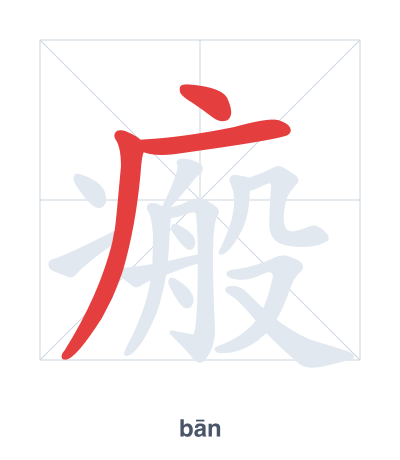
Open Hanzi Writer to see the animated stroke order and practice writing 瘢 with real-time feedback.
The character 瘢 (bān) is written with 15 strokes. Follow the standard Chinese stroke order: top to bottom, left to right, outside before inside. The radical 疒 is one of its key components.
Practice the correct stroke order with the Hanzi Writer app to see animated stroke-by-stroke guidance with real-time feedback.
瘢 means scar; mark; spot.
The character 瘢 combines the sickness radical 疒 with 般 (bān) as a phonetic component, originally denoting a mark left by illness or injury. The 般 component, composed of 舟 (boat) and 殳 (weapon), subtly suggests a patterned scar resembling boat-like impressions or weapon cuts.
💡 Memory Tip: Picture a sick person (疒) with a scar on their skin that looks like a boat (舟) that has been struck by a weapon (殳), leaving a permanent spot.
他的脸上留下了瘢痕。
tā de liǎn shàng liú xià le bān hén
A scar was left on his face.
皮肤上有一些瘢点。
pí fū shàng yǒu yī xiē bān diǎn
There are some spots on the skin.
伤口留下了瘢迹。
shāng kǒu liú xià le bān jì
The wound left a scar.
Open Hanzi Writer to see the animated stroke order and practice writing 瘢 with real-time feedback.
✨ Animated stroke order · Handwriting recognition · HSK-graded practice · Free to use
The character 瘢 combines the radical 疒 (illness or disease) with the phonetic component 般 (pronounced bān). The radical suggests a mark on the skin caused by disease or injury, while 般 provides the pronunciation and hints at the idea of a visible spot. Together, they mean 'scar' or 'blemish' on the body.