螯 (áo) means "Pincers / Claws (of a crustacean)" in Chinese. It has 16 strokes with the radical 虫.
Rated 4.2/5 in difficulty (advanced).
Appears in 3+ common words including 蟹螯 (xiè áo), 螯足 (áo zú), 巨螯 (jù áo).
Due to its 16 strokes, Hanzi Writer's error detection shows 螯 requires focused practice — most learners need 10+ attempts for consistent accuracy.
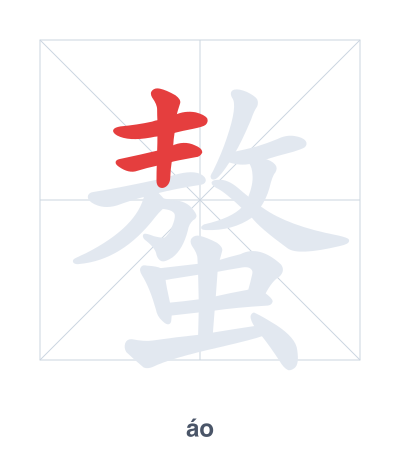
Open Hanzi Writer to see the animated stroke order and practice writing 螯 with real-time feedback.
The character 螯 (áo) is written with 16 strokes. Follow the standard Chinese stroke order: top to bottom, left to right, outside before inside. The radical 虫 is one of its key components.
Practice the correct stroke order with the Hanzi Writer app to see animated stroke-by-stroke guidance with real-time feedback.
螯 means Pincers / Claws (of a crustacean).
螯 is a compound character combining the radical 虫 (insect/creature) with 敖 as a phonetic component. The top part 敖 originally depicted a person with a weapon, but here it provides the sound áo while the radical indicates the meaning relates to animals like crabs or lobsters with pincers.
💡 Memory Tip: Picture a crab (虫) raising its two big claws shaped like the top strokes of 敖, pinching a square (方) piece of earth (土) with a loud 'Ao!' sound.
螃蟹的螯很大。
páng xiè de áo hěn dà
The crab's claws are very large.
它的螯足很有力。
tā de áo zú hěn yǒu lì
Its pincers are very powerful.
龙虾有一对巨螯。
lóng xiā yǒu yī duì jù áo
Lobsters have a pair of giant claws.
Open Hanzi Writer to see the animated stroke order and practice writing 螯 with real-time feedback.
✨ Animated stroke order · Handwriting recognition · HSK-graded practice · Free to use
螯 is made of 敖 (áo) on top and 虫 (chóng, insect/creature) below. The top part 敖 originally suggested a meaning of "clamp" or "pinch," while 虫 indicates it relates to a creature. Together, they form the idea of an insect-like animal's pincers or claws.