缒 (zhuì) means "to let down with a rope" in Chinese. It has 12 strokes with the radical 纟.
Rated 4.2/5 in difficulty (advanced).
Appears in 3+ common words including 缒下 (zhuì xià), 缒城 (zhuì chéng), 缒入 (zhuì rù).
Due to its 12 strokes, Hanzi Writer's error detection shows 缒 requires focused practice — most learners need 10+ attempts for consistent accuracy.
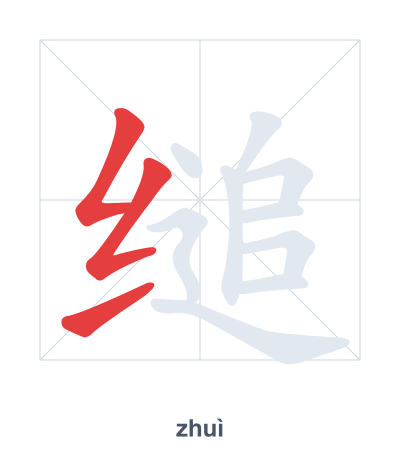
Open Hanzi Writer to see the animated stroke order and practice writing 缒 with real-time feedback.
The character 缒 (zhuì) is written with 12 strokes. Follow the standard Chinese stroke order: top to bottom, left to right, outside before inside. The radical 纟 is one of its key components.
Practice the correct stroke order with the Hanzi Writer app to see animated stroke-by-stroke guidance with real-time feedback.
缒 means to let down with a rope.
缒 combines the radical 纟 (silk thread, representing a rope) with 追 (zhuī, meaning 'to chase' but used here phonetically). The rope (纟) 'chases' (追) something downward as it is lowered.
💡 Memory Tip: Imagine a rope (纟) chasing (追) a heavy basket as it descends slowly from a high window.
他们用绳子把筐缒下。
tā men yòng shéng zi bǎ kuāng zhuì xià
They lowered the basket with a rope.
他半夜缒城而出。
tā bàn yè zhuì chéng ér chū
He lowered himself down the city wall at midnight.
救援人员被缒入深井。
jiù yuán rén yuán bèi zhuì rù shēn jǐng
Rescuers were lowered into the deep well by rope.
Open Hanzi Writer to see the animated stroke order and practice writing 缒 with real-time feedback.
✨ Animated stroke order · Handwriting recognition · HSK-graded practice · Free to use
缒 is composed of the radical 纟 (silk thread) on the left and 追 (zhuī, to chase) on the right. The silk radical suggests rope or cord, while 追 contributes the pronunciation and the idea of moving downward, together creating the meaning 'to let down with a rope.'