瘃 (zhú) means "chilblain" in Chinese. It has 13 strokes with the radical 疒.
Rated 4.2/5 in difficulty (advanced).
Appears in 3+ common words including 瘃子 (zhú zi), 冻瘃 (dòng zhú), 瘃疮 (zhú chuāng).
Due to its 13 strokes, Hanzi Writer's error detection shows 瘃 requires focused practice — most learners need 10+ attempts for consistent accuracy.
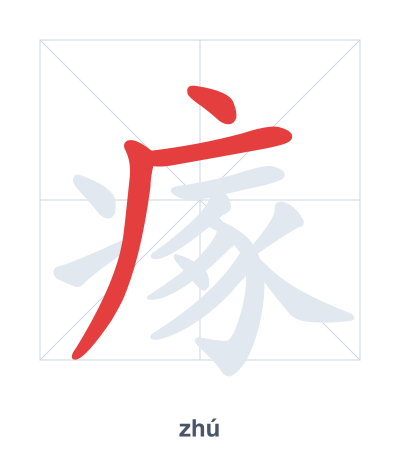
Open Hanzi Writer to see the animated stroke order and practice writing 瘃 with real-time feedback.
The character 瘃 (zhú) is written with 13 strokes. Follow the standard Chinese stroke order: top to bottom, left to right, outside before inside. The radical 疒 is one of its key components.
Practice the correct stroke order with the Hanzi Writer app to see animated stroke-by-stroke guidance with real-time feedback.
瘃 means chilblain.
The character 瘃 combines the sickness radical 疒 with a pig (豕) and a horizontal stroke symbolizing icy ground. In ancient cold climates, pigs often developed painful swollen feet (chilblains) from standing on frozen surfaces.
💡 Memory Tip: A sick pig (豕) with frostbitten trotters (疒) limps on ice — that's a chilblain.
他的手上长了瘃子。
tā de shǒu shàng zhǎng le zhú zi
He has chilblains on his hands.
冬天要注意预防冻瘃。
dōng tiān yào zhù yì yù fáng dòng zhú
In winter, one should be careful to prevent chilblains.
这个瘃疮很疼。
zhè ge zhú chuāng hěn téng
This frostbite is very painful.
Open Hanzi Writer to see the animated stroke order and practice writing 瘃 with real-time feedback.
✨ Animated stroke order · Handwriting recognition · HSK-graded practice · Free to use
The character 瘃 has the radical 疒 (sickness) on the outside, indicating it relates to illness or disease. Inside is 足 (zú, foot), pointing to chilblain typically affecting feet in cold weather.